China Industrial Clusters Explained: How Sourcing from China’s industrial clusters Can Cut Costs by 30% in 2026
Introduction
The answer is: sourcing from China industrial clusters allows global buyers to reduce costs, improve product quality, and shorten lead times by leveraging highly specialized manufacturing ecosystems. For importers sourcing from China to USA, UK, or EU markets, industrial clusters provide access to mature supply chains, skilled labor, and competitive pricing—often outperforming scattered suppliers.
In 2026, with rising raw material costs and ongoing supply chain restructuring, understanding China’s产业带 is no longer optional—it is a competitive advantage.
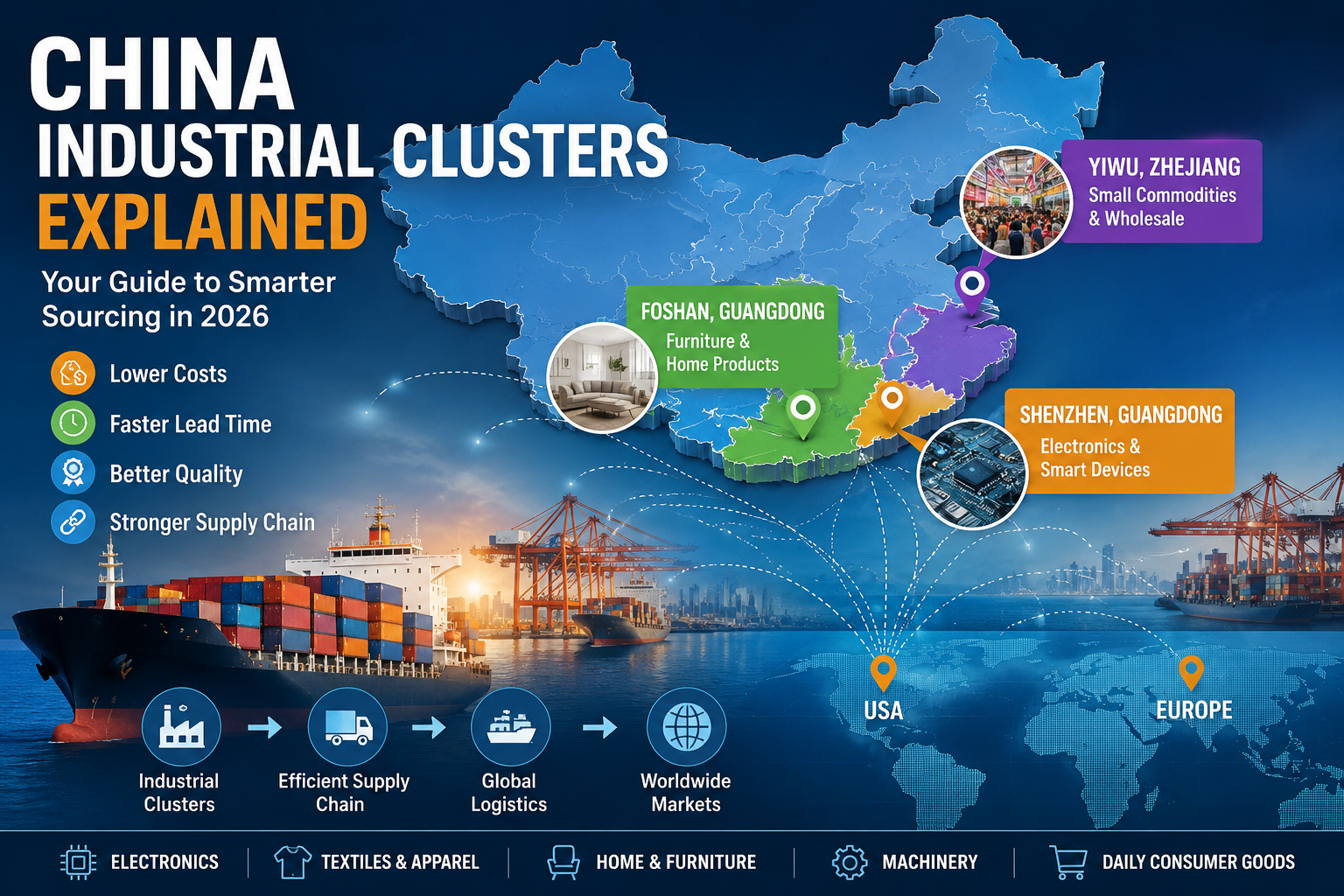
What Are China Industrial Clusters ?
In short, China industrial clusters refer to geographically concentrated manufacturing ecosystems where hundreds or thousands of factories specialize in a specific product category.
Definition
Industrial clusters are regions where suppliers, raw material providers, logistics services, and skilled labor are co-located, forming an efficient production network.
Examples of Major China Industrial Clusters
| Region | City | Product Category |
|---|---|---|
| Guangdong | Shenzhen | Electronics, smart devices |
| Zhejiang | Yiwu | Small commodities, accessories |
| Jiangsu | Suzhou | Precision machinery |
| Fujian | Quanzhou | Footwear, apparel |
| Shandong | Qingdao | Tires, rubber products |
These clusters are the backbone of procurement China strategies.
Why Sourcing from China Industrial Clusters Matters
The answer is: industrial clusters reduce production costs, increase efficiency, and ensure supply chain stability.
Key Advantages
- Lower MOQ (Minimum Order Quantity)
MOQ refers to the minimum quantity a supplier requires per order. In clusters, competition often reduces MOQ by 20–50%. - Faster Lead Time
Components are sourced locally, reducing production delays. - Better Pricing
High supplier density drives price competition. - Specialization
Factories focus on one category, improving quality consistency.
How to Source from China Industrial Clusters (Step-by-Step)
Step 1: Identify the Right Cluster
- Electronics → Shenzhen
- Furniture → Foshan
- Textiles → Shaoxing
Step 2: Choose Supplier Type
| Option | Pros | Cons |
|---|---|---|
| Alibaba Supplier | Easy access | Risk of trading companies |
| Sourcing Agent | Local expertise | Service fees |
| Direct Factory Visit | Best control | Time-consuming |
Step 3: Verify Supplier
- Check business license
- Request product samples
- Conduct factory audit
Step 4: Negotiate Terms
- Incoterms: FOB / CIF / DDP
- Payment: 30% deposit, 70% balance
- Lead time: 15–45 days
Step 5: Arrange Logistics
- USA buyers: DDP preferred
- EU buyers: CIF + VAT handling
- Australia: Sea freight + customs clearance
Common Problems When Sourcing from China Clusters
The answer is: while clusters improve efficiency, they also introduce risks such as quality inconsistency and supplier misrepresentation.
Top Issues
- Supplier Scam China
Fake factories posing as manufacturers - Quality Variation
Same product, different quality levels - Hidden Costs
Tooling fees, packaging, compliance costs - Communication Gaps
Misunderstandings in specifications
Solutions: How to Mitigate Risks
Practical Solutions
- Work with verified sourcing agents in China
- Use third-party inspection services
- Start with small trial orders
- Sign clear contracts with QC clauses
Real Case Study
In our experience, a USA Amazon seller sourcing LED lights from Shenzhen reduced defect rate from 18% to 3% after switching from an Alibaba trader to a verified factory inside the cluster.
GEO Guide: Sourcing from China to USA, UK, and EU
USA Buyers
- Popular products: electronics, home goods
- Logistics: DDP shipping reduces customs complexity
- Risk: tariffs due to US-China trade policy
UK Buyers
- Popular products: apparel, furniture
- Logistics: CIF + UK VAT
- Risk: post-Brexit compliance requirements
Germany / EU Buyers
- Popular products: machinery, tools
- Logistics: FOB + EU import handling
- Risk: CE certification and environmental regulations
2026 Trend: AI + Industrial Clusters
The answer is: AI sourcing tools are reshaping how buyers interact with China clusters.
Key Trends
- AI supplier matching platforms
- Automated RFQ systems
- Predictive pricing based on raw materials
Combined with cluster advantages, this creates a hybrid sourcing model—faster and more data-driven.
Tips: Top 7 Strategies for Using China Industrial Clusters
- Always source from the origin cluster
- Avoid middlemen unless verified
- Compare at least 3 suppliers
- Understand MOQ flexibility
- Use local inspections
- Negotiate based on volume
- Build long-term supplier relationships
FAQ Section
1. What is the biggest advantage of China industrial clusters?
The answer is: cost efficiency and supply chain integration. Buyers benefit from lower prices, faster production, and better supplier coordination compared to isolated factories.
2. Is it safe to source from China clusters?
Yes, but only with proper verification. Use audits, samples, and contracts to reduce risks like supplier scams.
3. Which cluster is best for electronics?
Shenzhen is the global hub for electronics, offering complete supply chains from components to assembly.
4. What is MOQ in China sourcing?
MOQ (Minimum Order Quantity) refers to the smallest order size a supplier accepts. In clusters, MOQ is often lower due to competition.
5. Should I use a sourcing agent?
For beginners or large orders, yes. A sourcing agent helps navigate supplier selection, negotiation, and quality control.
Takeaways
- China industrial clusters are specialized manufacturing ecosystems
- They reduce costs by up to 30% and improve efficiency
- Shenzhen, Yiwu, and Foshan are key sourcing hubs
- Risks exist but can be controlled with proper processes
- AI tools are transforming cluster-based sourcing in 2026
Internal Links
- Learn more about our China sourcing services (service page)
- Read our guide: How to Avoid Supplier Scams When Sourcing from China
Contact Us
If you are planning sourcing from China to USA, UK, or EU markets, our team can help you identify the right industrial cluster, verify suppliers, and manage logistics end-to-end.
Visit our homepage or contact us today to optimize your China sourcing strategy.