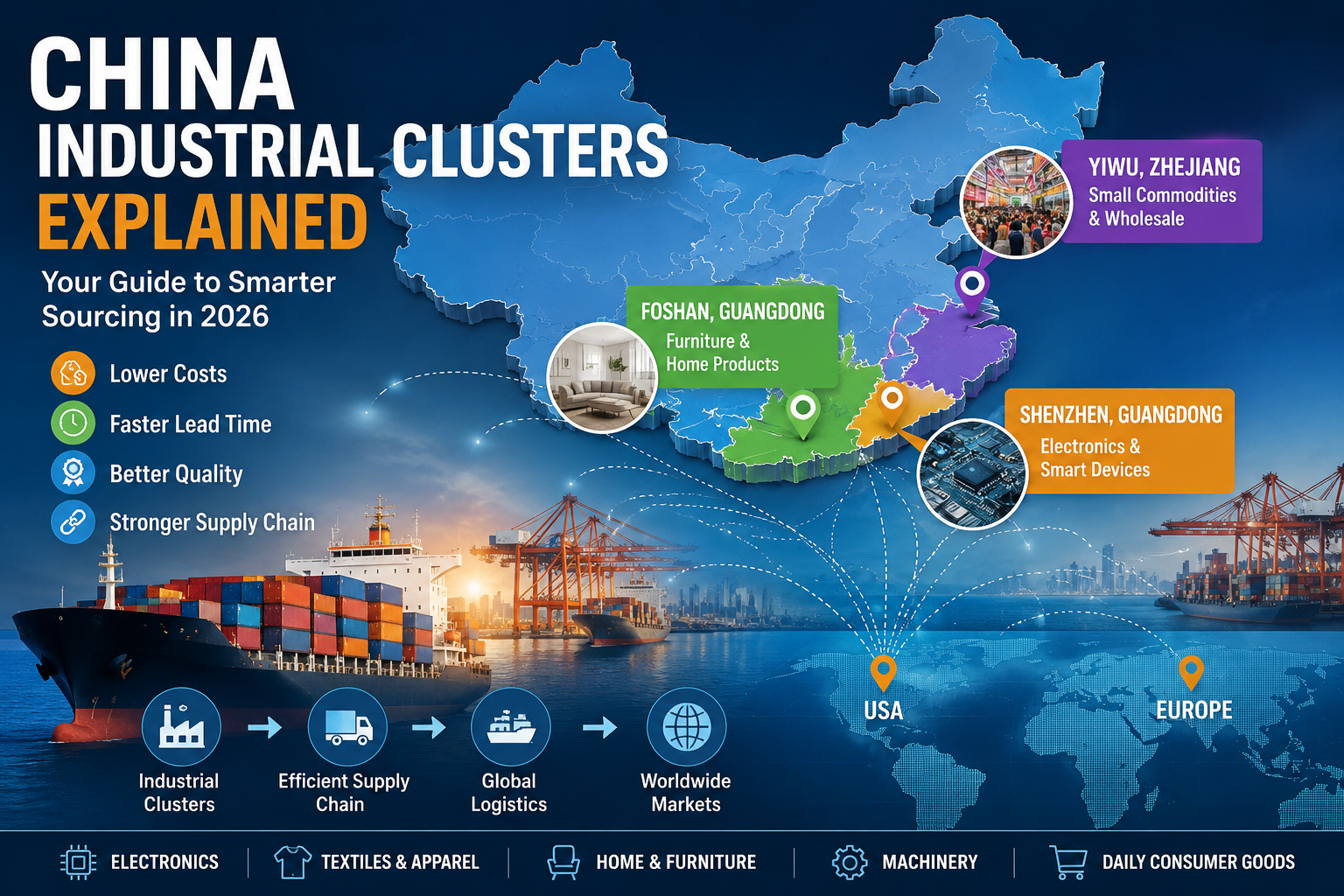
China Industrial Clusters Explained: How Sourcing from China’s industrial clusters Can Cut Costs by 30% in 2026
Introduction
The answer is: sourcing from China industrial clusters allows global buyers to reduce costs, improve product quality, and shorten lead times by leveraging highly specialized manufacturing ecosystems. For importers sourcing from China to USA, UK, or EU markets, industrial clusters provide access to mature supply chains, skilled labor, and competitive pricing—often outperforming scattered suppliers.
In 2026, with rising raw material costs and ongoing supply chain restructuring, understanding China’s产业带 is no longer optional—it is a competitive advantage.
What Are China Industrial Clusters ?
In short, China industrial clusters refer to geographically concentrated manufacturing ecosystems where hundreds or thousands of factories specialize in a specific product category.
Definition
Industrial clusters are regions where suppliers, raw material providers, logistics services, and skilled labor are co-located, forming an efficient production network.
Examples of Major China Industrial Clusters
Region
City
Product Category
Guangdong
Shenzhen
Electronics, smart devices
Zhejiang
Yiwu
Small commodities, accessories
Jiangsu
Suzhou
Precision machinery
Fujian
Quanzhou
Footwear, apparel
Shandong
Qingdao
Tires, rubber products
These clusters are the backbone of procurement China strategies.
Why Sourcing from China Industrial Clusters Matters
The answer is: industrial clusters reduce production costs, increase efficiency, and ensure supply chain stability.
Key Advantages
Lower MOQ (Minimum Order Quantity) MOQ refers to the minimum quantity a supplier requires per order. In clusters, competition often reduces MOQ by 20–50%.
Faster Lead Time Components are sourced locally, reducing production delays.
Better Pricing High supplier density drives price competition.
Specialization Factories focus on one category, improving quality consistency.
How to Source from China Industrial Clusters (Step-by-Step)
Step 1: Identify the Right Cluster
Electronics → Shenzhen
Furniture → Foshan
Textiles → Shaoxing
Step 2: Choose Supplier Type
Option
Pros
Cons
Alibaba Supplier
Easy access
Risk of trading companies
Sourcing Agent
Local expertise
Service fees
Direct Factory Visit
Best control
Time-consuming
Step 3: Verify Supplier
Check business license
Request product samples
Conduct factory audit
Step 4: Negotiate Terms
Incoterms: FOB / CIF / DDP
Payment: 30% deposit, 70% balance
Lead time: 15–45 days
Step 5: Arrange Logistics
USA buyers: DDP preferred
EU buyers: CIF + VAT handling
Australia: Sea freight + customs clearance
Common Problems When Sourcing from China Clusters
The answer is: while clusters improve efficiency, they also introduce risks such as quality inconsistency and supplier misrepresentation.
Top Issues
Supplier Scam China Fake factories posing as manufacturers
Quality Variation Same product, different quality levels
Communication Gaps Misunderstandings in specifications
Solutions: How to Mitigate Risks
Practical Solutions
Work with verified sourcing agents in China
Use third-party inspection services
Start with small trial orders
Sign clear contracts with QC clauses
Real Case Study
In our experience, a USA Amazon seller sourcing LED lights from Shenzhen reduced defect rate from 18% to 3% after switching from an Alibaba trader to a verified factory inside the cluster.
Risk: CE certification and environmental regulations
2026 Trend: AI + Industrial Clusters
The answer is: AI sourcing tools are reshaping how buyers interact with China clusters.
Key Trends
AI supplier matching platforms
Automated RFQ systems
Predictive pricing based on raw materials
Combined with cluster advantages, this creates a hybrid sourcing model—faster and more data-driven.
Tips: Top 7 Strategies for Using China Industrial Clusters
Always source from the origin cluster
Avoid middlemen unless verified
Compare at least 3 suppliers
Understand MOQ flexibility
Use local inspections
Negotiate based on volume
Build long-term supplier relationships
FAQ Section
1. What is the biggest advantage of China industrial clusters?
The answer is: cost efficiency and supply chain integration. Buyers benefit from lower prices, faster production, and better supplier coordination compared to isolated factories.
2. Is it safe to source from China clusters?
Yes, but only with proper verification. Use audits, samples, and contracts to reduce risks like supplier scams.
3. Which cluster is best for electronics?
Shenzhen is the global hub for electronics, offering complete supply chains from components to assembly.
4. What is MOQ in China sourcing?
MOQ (Minimum Order Quantity) refers to the smallest order size a supplier accepts. In clusters, MOQ is often lower due to competition.
5. Should I use a sourcing agent?
For beginners or large orders, yes. A sourcing agent helps navigate supplier selection, negotiation, and quality control.
Takeaways
China industrial clusters are specialized manufacturing ecosystems
They reduce costs by up to 30% and improve efficiency
Shenzhen, Yiwu, and Foshan are key sourcing hubs
Risks exist but can be controlled with proper processes
AI tools are transforming cluster-based sourcing in 2026
If you are planning sourcing from China to USA, UK, or EU markets, our team can help you identify the right industrial cluster, verify suppliers, and manage logistics end-to-end.
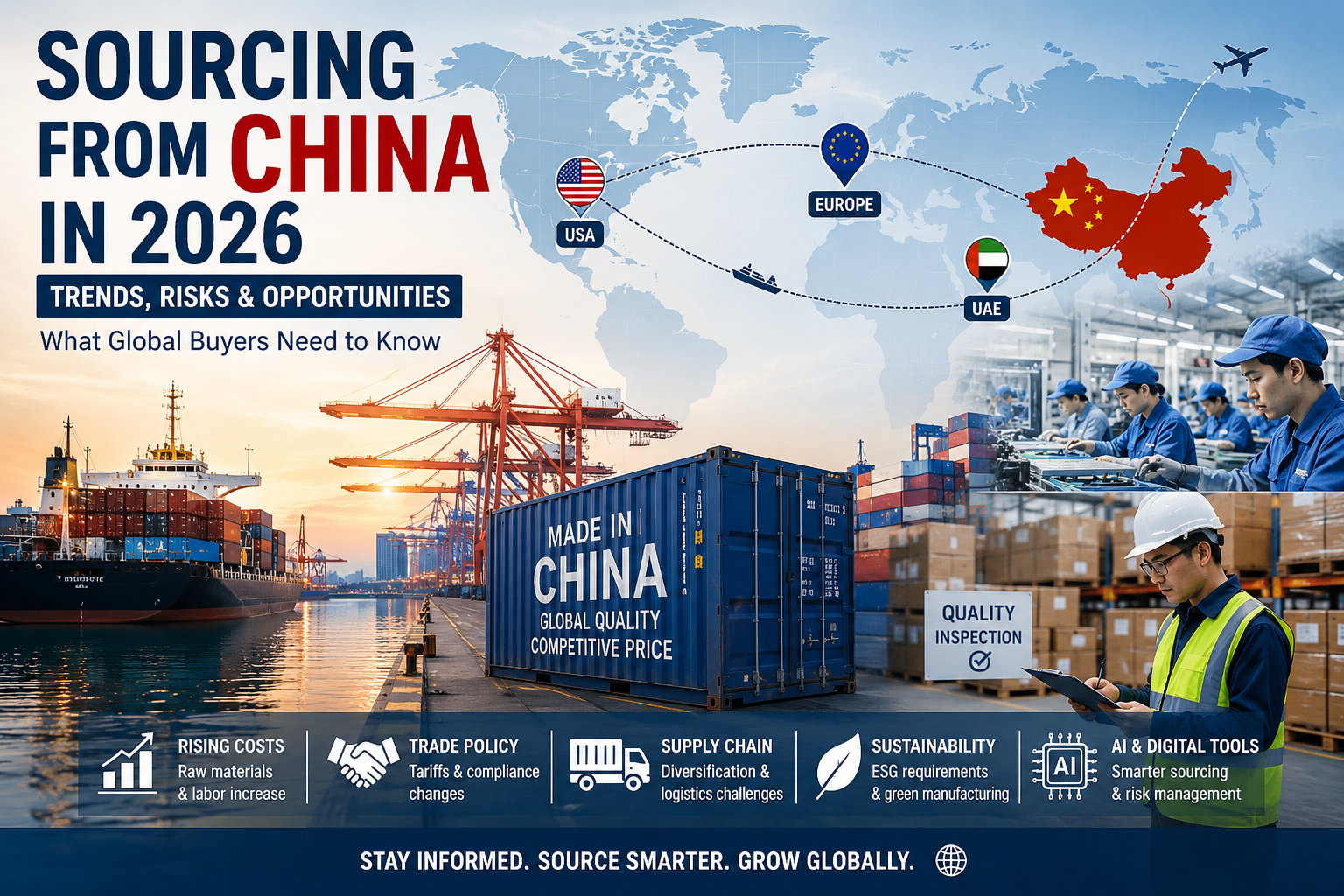
Sourcing from China in 2026: Latest Global Trade Trends, Risks, and Opportunities for USA, EU, and UAE Buyers
Introduction
In short, sourcing from China in 2026 is becoming more complex but still highly competitive due to supply chain shifts, rising costs, and geopolitical changes. Buyers from the USA, EU, and UAE must adapt to new pricing structures, logistics disruptions, and compliance rules while leveraging AI tools and diversified sourcing strategies to stay competitive.
What Are the Latest Global Trade Trends in Sourcing from China?
The answer is: Global sourcing from China is shifting from low-cost manufacturing to strategic supply chain management.
In 2025–2026, several macro trends are reshaping procurement:
Rising labor and raw material costs (steel +12%, plastics +8%)
Increased US-China trade tariffs
Supply chain diversification
Growth of cross-border eCommerce (Amazon, temu, tiktok, Shopify sellers)
Adoption of AI sourcing tools
Definition: China sourcing refers to the process of procuring goods from Chinese manufacturers or suppliers, typically through direct factories, trading companies, or sourcing agents.
Why Is Sourcing from China Still Relevant in 2026?
Despite challenges, China remains dominant due to its infrastructure and scale.
Key Advantages
Mature manufacturing clusters (Shenzhen for electronics, Yiwu for small commodities)
Efficient ports like Ningbo Port and Shenzhen Port
Strong supplier ecosystem
Competitive pricing vs. Vietnam/India in many categories
Real Case
In our experience, a USA Amazon seller sourcing kitchen appliances from Ningbo reduced costs by 18% compared to local sourcing, even after tariffs, by switching to FOB + bulk shipping strategy.
How Are Recent Trade Events Affecting China Sourcing?
1. US-China Trade Policy Changes
Tariffs still apply on many categories (electronics, machinery)
Buyers shifting to DDP shipping to simplify customs
2. EU Green Compliance (ESG Pressure)
Germany and EU buyers require:
CE certification
Carbon footprint documentation
Sustainable materials
3. Middle East (UAE) Import Growth
Increased demand for:
Construction materials
Furniture
Electronics
Preference for CIF or DDP shipping to Dubai
How to Adapt Your Sourcing Strategy in 2026 (Step-by-Step)
Step 1: Choose the Right Supplier Type
Option
Pros
Cons
Best For
Alibaba Supplier
Easy access
Risk of scams
Small buyers
Direct Factory
Lower price
Higher MOQ
Large orders
Sourcing Agent
Quality control
Service fee
Scaling brands
👉 Learn more: How to avoid supplier scams when sourcing from China (internal link)
Step 2: Understand MOQ and Cost Structure
MOQ (Minimum Order Quantity) refers to the smallest number of units a supplier is willing to produce per order.
Typical MOQ:
Electronics: 500–1000 units
Apparel: 300–500 pieces
Furniture: 50–100 sets
Step 3: Optimize Shipping Method
Method
Cost
Speed
Use Case
FOB
Medium
Medium
Experienced importers
CIF
Higher
Medium
EU buyers
DDP
Highest
Fast
USA / UAE eCommerce
Step 4: Use AI Tools for Supplier Verification
Trend: AI procurement tools are reducing sourcing risk.
Analyze supplier reviews
Detect fake certificates
Predict pricing trends
Step 5: Conduct Quality Inspection
In our experience, pre-shipment inspection reduces defect rates from 20% to below 5%.
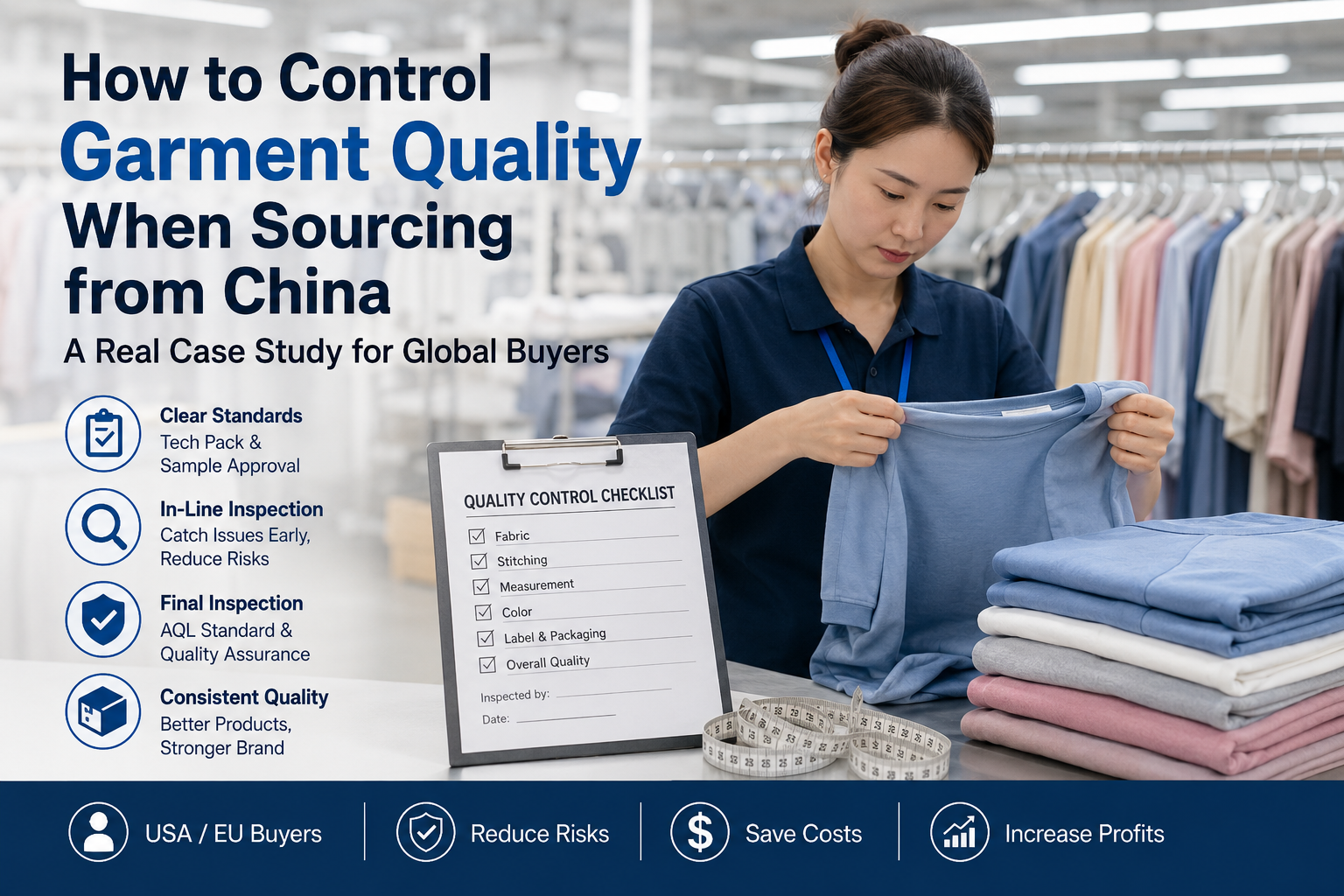
How to Control Garment Quality When Sourcing from China: A Real Case Study for Global Buyers
Introduction
In short, controlling garment quality when sourcing from China requires strict pre-production standards, in-line inspections, and final quality control backed by clear specifications and contracts. Many USA, UK, and EU buyers fail not because of bad suppliers, but because of weak quality control systems.
This article shares a real apparel sourcing case and a step-by-step quality control framework to help you avoid costly mistakes when importing clothing from China.
What is Garment Quality Control in China Sourcing?
Garment quality control refers to a structured process of ensuring clothing products meet agreed standards, specifications, and compliance requirements before shipment.
The answer is: It includes fabric inspection, size measurement, stitching checks, labeling verification, and packaging standards, typically conducted at three stages: pre-production, during production, and pre-shipment.
Key Quality Elements in Apparel
Fabric composition (e.g., 100% cotton vs blended)
GSM (grams per square meter)
Stitch density and durability
Color fastness
Size tolerance (+/- 1–2 cm)
Packaging accuracy
Why Quality Control is Critical for USA & EU Buyers
For buyers importing garments to USA, UK, Germany, and Canada, quality issues can lead to:
Amazon or Shopify negative reviews
Customs rejection (compliance issues like CPSIA in the USA)
Return rates above 20%
Brand damage
Example: Compliance Requirements
Country
Requirement
Risk
USA
CPSIA labeling
Shipment held
EU (Germany)
REACH chemical compliance
Fines
UK
Fiber labeling accuracy
Retail rejection
Real Case Study: 30% Defect Rate in Women’s Dresses (USA Buyer)
Background
Buyer: USA Shopify brand
Product: Women’s summer dresses
Quantity: 5,000 pcs
Supplier location: Guangzhou, China
Trade term: FOB Shenzhen
Problem
After receiving goods, the buyer discovered:
30% dresses had size deviation >3cm
Loose stitching in shoulder areas
Color mismatch vs approved sample
Root Causes
1. No Pre-Production Sample Approval
The buyer approved photos, not physical samples.
2. No Size Spec Sheet
Supplier used their own “standard size,” not the buyer’s.
3. No In-line Inspection
Problems were discovered too late (after production finished).
How We Solved It: Step-by-Step Quality Control System
Step 1: Create a Detailed Tech Pack
A Tech Pack (Technical Package) defines all product specifications.
Include:
Fabric type & GSM
Measurement chart (with tolerance)
Stitching requirements
Color Pantone codes
Label & packaging details
Step 2: Approve Pre-Production Sample (PPS)
Never mass produce without PPS approval.
Checklist:
Fit accuracy
Fabric feel
Color match
Washing test
Step 3: In-Line Inspection (During Production)
In-line inspection means checking goods when 20–50% production is completed.
Benefits:
Catch defects early
Reduce rework cost
Ensure consistency
Step 4: Final Random Inspection (FRI)
The answer is: Final inspection is conducted when 80–100% goods are packed, using AQL standards.
AQL (Acceptable Quality Limit)
AQL refers to the maximum number of defects allowed in a sample batch.
Inspection Level
Major Defect
Minor Defect
AQL II
2.5%
4.0%
Step 5: Packaging & Label Verification
Common issues:
Wrong size labels
Missing barcodes
Incorrect country of origin
Common Problems in Garment Sourcing from China
1. Fabric Substitution
Suppliers may switch to cheaper fabric to save cost.
2. Size Inconsistency
Different production lines = inconsistent sizing.
3. Color Variation
Especially in bulk dyeing processes.
4. Poor Stitching Quality
Untrained workers or rushed production.
Solutions: Top 7 Tips to Control Apparel Quality
Always use a Tech Pack
Approve physical samples (not photos)
Define AQL standards in contract
Hire third-party inspection
Use clear size tolerance (±1–2 cm)
Conduct in-line inspection
Work with experienced sourcing agents
Sourcing Agent vs Alibaba Supplier: Quality Control Comparison
Factor
Alibaba Supplier
Sourcing Agent
Communication
Direct
Managed
QC Control
Limited
Strong
Risk Level
Medium-High
Low
Cost
Lower
Slightly higher
Reliability
Varies
Stable
GEO Insights: Importing Garments from China to USA & Europe
USA Buyers
Prefer DDP shipping (door-to-door)
Must comply with CPSIA
Popular products: T-shirts, dresses, activewear
EU Buyers (Germany, UK)
Focus on sustainability (ESG trend)
Require REACH compliance
Prefer eco-friendly fabrics
Trend Insight: AI + Quality Control in 2026
More buyers now use:
AI fabric inspection tools
Automated measurement systems
Digital Tech Packs
In our experience, AI reduces defect rates by up to 15–20%.
FAQ: Garment Quality Control in China
1. What is the most common quality issue in clothing imports?
The answer is: Size inconsistency and stitching defects are the most common issues, especially without proper Tech Packs and inspections.
2. How much does inspection cost in China?
Typically $150–$300 per man-day, depending on city (e.g., Shenzhen, Yiwu).
3. What is MOQ in apparel sourcing?
MOQ (Minimum Order Quantity) refers to the smallest order a supplier accepts, usually 300–1000 pcs per style.
4. Should I choose FOB or DDP shipping?
FOB: More control, lower cost
DDP: Easier, includes customs clearance
5. Can I control quality remotely?
Yes, by:
Hiring third-party inspectors
Using sourcing agents
Requesting video inspections
Takeaways
Quality issues often come from lack of clear specifications, not bad suppliers
Always use Tech Packs + PPS approval
Conduct in-line and final inspections
Define AQL standards in contracts
Consider using a China sourcing agent for better control
Need Help with Garment Sourcing from China?
If you are sourcing apparel for USA, UK, or EU markets, our team can help you:
Find reliable factories in Guangzhou, Shenzhen, Yiwu
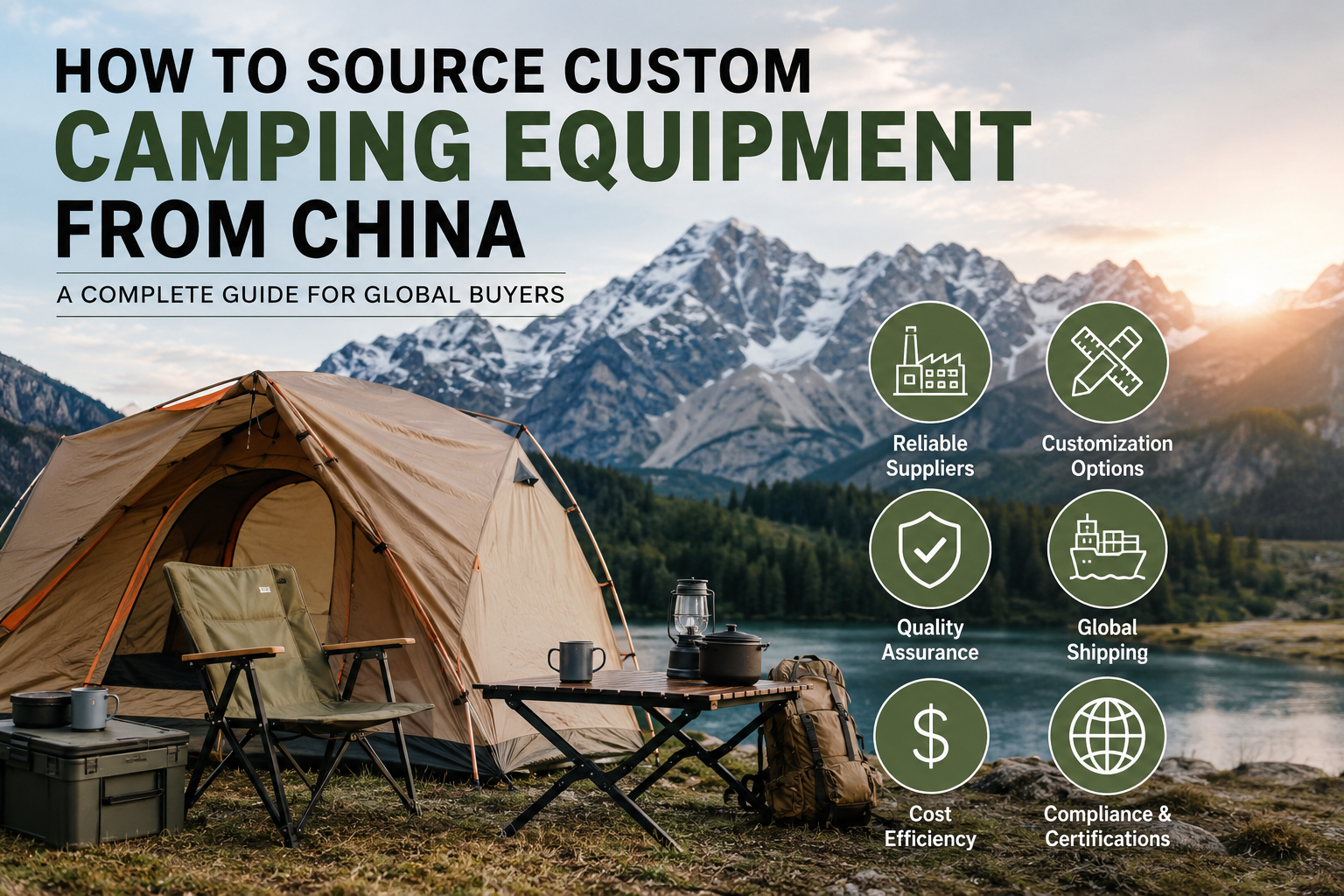
How to Source Custom Camping Equipment from China: A Complete Guide for Global Buyers (2026)
Introduction
Sourcing custom camping equipment from China is one of the most cost-effective ways to build a competitive outdoor brand. In short, the answer is: you can successfully source high-quality customized camping gear from China by selecting the right supplier, managing MOQ, ensuring compliance, and controlling logistics. This guide explains exactly how to do it step by step, especially for buyers in the USA, UK, Germany, and Australia.
What is Custom Camping Equipment Sourcing from China?
Custom camping equipment sourcing from China refers to the process of designing, manufacturing, and importing personalized outdoor gear—such as tents, sleeping bags, and camping furniture—from Chinese suppliers.
Key Definition (Featured Snippet Ready)
MOQ (Minimum Order Quantity) refers to the smallest number of units a supplier is willing to produce per order. In China, MOQ for camping gear typically ranges from 100 to 1,000 units depending on complexity.
Common Custom Camping Products
Product Category
Custom Options
Typical MOQ
Camping tents
Size, fabric, logo
200–500
Sleeping bags
Temperature rating, material
300–800
Camping chairs
Frame, color, branding
200–1000
Outdoor cookware
Material, packaging
500–2000
Backpacks
Design, capacity, logo
300–1000
Why Source Camping Gear from China?
The answer is: China offers unmatched manufacturing capacity, lower costs, and flexible customization options compared to other regions.
Key Advantages
Cost Efficiency: Up to 30–50% cheaper than Western manufacturing
Supply Chain Ecosystem: Cities like Shenzhen, Ningbo, and Yiwu specialize in outdoor products
Customization Capability: OEM/ODM services widely available
Scalability: Easy to scale from small batches to mass production
Real Case
In our experience, a US-based Amazon seller sourcing camping hammocks from Ningbo reduced costs by 42% while maintaining quality, increasing profit margins by 18%.
How to Source Custom Camping Equipment from China (Step-by-Step)
Step 1: Define Your Product Requirements
Clearly specify:
Materials (e.g., 210T polyester, aluminum alloy)
Dimensions and weight
Branding (logo, packaging)
Certifications (CE, FDA, CPSIA)
Step 2: Find Reliable Suppliers
You can use:
Alibaba
Trade shows (Canton Fair)
Sourcing agents in China
Supplier Comparison Table
Option
Pros
Cons
Alibaba
Wide selection
Risk of scams
Sourcing Agent
Local expertise
Service fee
Factory Direct
Lower cost
Communication barriers
👉 Related Service: China Sourcing Agent Services 👉 Read more: How to Verify Chinese Suppliers
Step 3: Request Samples
Always test:
Material quality
Stitching and durability
Packaging
Typical sample cost: $50–$200
Step 4: Negotiate MOQ and Pricing
In short: MOQ is negotiable, especially for new buyers.
Tips:
Start with smaller trial orders
Bundle multiple products
Offer long-term cooperation
Step 5: Production & Quality Control
Use:
Pre-production samples
Mid-production inspection
Final inspection (AQL standard)
Example: A German buyer reduced defect rate from 12% to 2% using third-party QC in Shenzhen.
Step 6: Shipping & Logistics
Common shipping terms:
Term
Meaning
Best For
FOB
Free on Board
Experienced importers
CIF
Cost + Insurance + Freight
Balanced control
DDP
Delivered Duty Paid
Beginners
Country-Specific Tips
USA
Import duty varies (typically 5–12%)
Amazon FBA requires strict packaging
UK
Post-Brexit customs checks stricter
VAT must be pre-registered
Germany
Strong compliance (REACH standards)
Eco-friendly packaging preferred
Australia
Biosecurity inspections for outdoor gear
Strict wood material regulations
Common Problems When Sourcing from China
1. Supplier Scams
The answer is: scams often involve fake factories or low-quality substitutions.
2. Quality Issues
Inconsistent materials
Poor workmanship
3. Delayed Shipments
Due to:
Supply chain disruptions
Raw material price increases (a major 2025–2026 trend)
4. Communication Gaps
Language and time zone differences
Solutions to Avoid Risks
Supplier Verification Checklist
Business license
Factory audit
Trade assurance
Quality Control Strategy
Hire third-party inspection
Use detailed product specs
Set penalty clauses
Logistics Optimization
Use freight forwarders
Plan for peak seasons (Q4 delays common)
Top 7 Tips for Successful Sourcing
Start with small orders to test suppliers
Always get samples before bulk production
Negotiate MOQ strategically
Use a sourcing agent if new
Understand your country’s import regulations
Build long-term supplier relationships
Monitor global supply chain trends (e.g., rising material costs)
Trends in Camping Equipment Sourcing (2026)
1. Eco-Friendly Materials
Recycled fabrics
Sustainable packaging
2. E-commerce Growth
Amazon and Shopify brands are driving demand for private-label camping gear.
3. AI Sourcing Tools
AI helps identify reliable suppliers and predict pricing trends.
FAQ (Frequently Asked Questions)
1. How much does it cost to source camping equipment from China?
The answer is: Costs vary by product, but typically range from $5 to $50 per unit, excluding shipping. Bulk orders significantly reduce per-unit cost.
2. What is the typical MOQ for camping gear?
In short: MOQ usually ranges from 100 to 1000 units depending on the product and customization level.
3. How long does production take?
The answer is: Production typically takes 15–45 days, plus 20–40 days for shipping depending on the destination.
4. Is DDP shipping safe for beginners?
Yes. DDP (Delivered Duty Paid) is the easiest option for beginners because the supplier handles customs and delivery.
5. How do I avoid low-quality suppliers?
In short: verify licenses, request samples, and use third-party inspections before shipment.
Takeaways
Sourcing custom camping equipment from China can reduce costs by up to 50%
MOQ, quality control, and logistics are the three key success factors
Always verify suppliers and test samples before bulk orders
Choose the right shipping method based on your experience level
Stay updated with trends like eco-friendly materials and AI sourcing
Ready to Start Sourcing?
If you’re planning to import camping equipment from China to the USA, UK, Germany, or Australia, working with a reliable sourcing partner can save time and reduce risk.
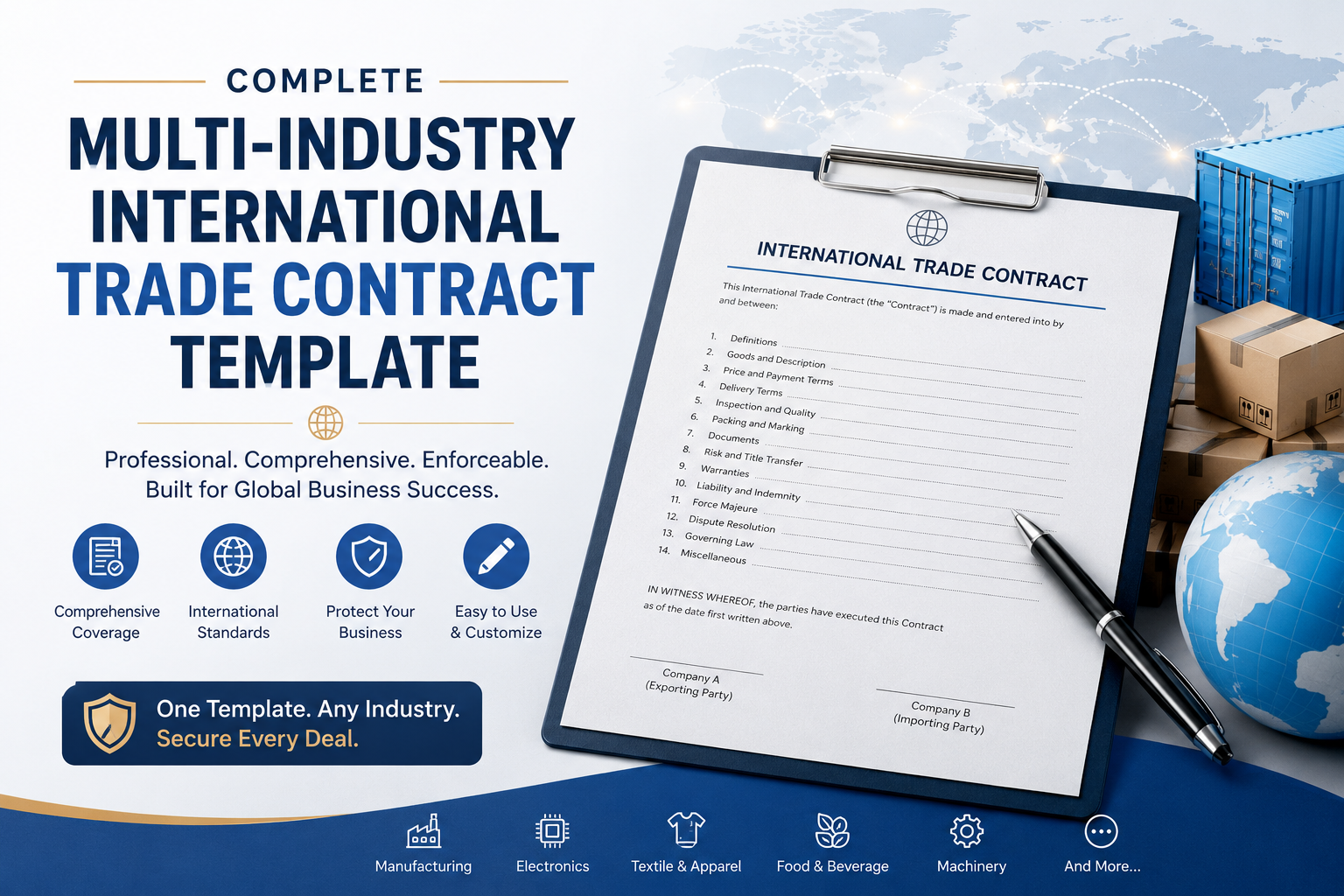
Complete Multi-Industry International Trade Contract Template
Publication Note: This article provides a comprehensive, designed for businesses across multiple industries—from raw materials and manufacturing parts to consumer goods, equipment, machinery, and industrial solutions. The template is ready for direct download, print, and contract signing. All blank fields are clearly marked for easy completion.
How to Use This Template
This International Sale Contract is designed for business-to-business (B2B) cross-border transactions. It is suitable for:
Raw materials (minerals, agricultural products, chemicals)
Manufacturing parts and components
Consumer goods
Equipment and machinery
Industrial solutions
The model follows internationally recognized standards including the UN Convention for the International Sale of Goods (CISG) and ICC Incoterms® Rules. Each ICC Model Contract includes a fully editable version, permitting you to easily adapt the contract to your specific case.
⚠️ Important: As with any model contract, it should be reviewed by a qualified lawyer before signature to ensure compliance with relevant local legal and regulatory requirements.
INTERNATIONAL SALE CONTRACT
Contract No.: ______________________
Date: ______________________
BETWEEN:
THE SELLER:
Company Legal Name: ________________________________
Country of Origin: ___________________________________________________________
ARTICLE 2 — PRICE
The total price of the Products which the Buyer undertakes to pay the Seller shall be:
Total Amount (in numbers): ________________________________
Total Amount (in words): ________________________________
Currency: ________________________________
The aforementioned price:
□ Is the sum total of the prices of all Products and quantities as set out in Article 1
□ Is the sum total of the prices of all Products and quantities as set out in Annex 1
Price Revision Clause (optional): Both Parties undertake to renegotiate the agreed price when affected by significant changes in the international market, or by political, economic or social situations in the country of dispatch or destination of the Product, which may damage the interests of either party.
Mode of Transport: [ ] Sea [ ] Air [ ] Road [ ] Rail [ ] Multimodal
Partial Shipments: [ ] Allowed [ ] Not Allowed
Transshipment: [ ] Allowed [ ] Not Allowed
The goods shall be delivered at the agreed place, and to the transport agent designated by the Buyer, at least twenty-four hours before the deadline established in the present Contract. Should the Buyer fail to take charge of the goods on arrival, the Seller shall be entitled to demand the fulfillment of the Contract and payment of the agreed price.
ARTICLE 4 — PACKAGING AND MARKING
The Seller undertakes to deliver the Products hereunder, suitably wrapped and packaged for their specific characteristics and for the conditions of transport to be used.
Goods shall be packed in strong ________________ (wooden cases / cartons / containers / other) suitable for long-distance ________________ (ocean / air / road) transportation and well protected against moisture, shock, rust, and corrosion.
The Seller shall mark on each package with non-fading paint the following: package number, gross weight, net weight, dimensions, and the words “HANDLE WITH CARE,” “KEEP AWAY FROM MOISTURE,” and “THIS SIDE UP”.
ARTICLE 5 — INSPECTION AND QUALITY CONTROL
The goods shall be inspected by _________________________________________ before shipment.
The Seller guarantees that the goods meet the required quality standards and are free from defects in material and workmanship.
Inspection Certificate: The quality, specifications, quantity and weight of the goods shall be certified by ________________________________ (e.g., the Inspection Bureau or an independent surveyor).
ARTICLE 6 — PAYMENT TERMS
The Buyer undertakes to pay the total price which appears in the present Contract. Payment shall be effected by the following method (select one):
□ Letter of Credit (L/C): Irrevocable, confirmed Letter of Credit payable at sight, to be opened by the Buyer in favor of the Seller through ________________ Bank, valid for ______ days after shipment.
□ Bank Transfer / Wire Transfer: Direct transfer to the Seller’s bank account as specified below.
□ Documents Against Payment (D/P): Through collection via ________________ Bank.
□ Advance Payment: ____% upon contract signing, balance ____% before shipment.
Immediately after the goods are shipped, the Seller shall notify the Buyer by ________________ (email / fax / telex) of the contract number, product name, quantity, invoice value, vessel/flight number, port of loading, port of destination, and expected arrival date.
ARTICLE 10 — WARRANTY AND CLAIMS
Warranty Period: The Seller warrants that the goods shall be free from defects for a period of ________________ months from the date of ________________ (shipment / delivery / installation).
Claims Notification: Any claims regarding defects, quality issues, or shortages must be reported in writing within ________________ days of receipt of the goods.
Claim Settlement: The Seller shall, at its option, either replace the defective goods, repair them, or refund the purchase price, provided that the Buyer’s claim is found to be valid.
ARTICLE 11 — FORCE MAJEURE
Neither party shall be liable for delays or failures caused by events beyond their reasonable control, including but not limited to: natural disasters, war, hostilities, military actions, blockade, government restrictions, import/export prohibitions, epidemics, pandemics, strikes, or any other circumstances beyond the parties’ will.
If a Force Majeure event occurs, the affected party shall:
Notify the other party in writing within ________________ days of its occurrence
Provide a certificate of the event issued by the relevant Chamber of Commerce or competent authority
If the Force Majeure event continues for more than ________________ days, either party shall have the right to terminate the Contract without liability to the other party.
ARTICLE 12 — INTELLECTUAL PROPERTY
The Seller warrants that the goods do not infringe upon any intellectual property rights (including but not limited to patents, trademarks, copyrights, or industrial designs) of any third party. The Seller shall indemnify and hold the Buyer harmless against any claims, damages, or expenses arising from any such infringement.
ARTICLE 13 — CONFIDENTIALITY
Both Parties undertake to keep confidential all commercial, technical, and financial information disclosed during the negotiation and performance of this Contract. This obligation shall survive the termination of this Contract for a period of ________________ years.
ARTICLE 14 — GOVERNING LAW
This Contract shall be governed by and construed in accordance with:
□ The UN Convention on Contracts for the International Sale of Goods (CISG)
□ The laws of ________________________________ (specify country)
□ The UNIDROIT Principles of International Commercial Contracts
Note: The CISG applies to an increasingly large volume of international sales and is recommended for cross-border transactions.
ARTICLE 15 — DISPUTE RESOLUTION
Any dispute arising out of or in connection with this Contract shall be resolved as follows:
□ Friendly Negotiations: The Parties shall first attempt to resolve the dispute through good-faith negotiations.
If negotiations fail, the dispute shall be settled by:
□ Arbitration: Under the rules of ________________________________ Arbitration Commission, in ________________ (city/country). The arbitration award shall be final and binding upon both Parties.
□ Litigation: Before the competent courts of ________________________________ (specify jurisdiction).
Language of Proceedings: ________________________________
ARTICLE 16 — TERMINATION
This Contract may be terminated by either Party:
By mutual written agreement of both Parties
By either Party upon ________________ days’ written notice to the other Party in the event of a material breach that remains uncured for ________________ days after written notice thereof
Immediately in the event of insolvency, bankruptcy, or cessation of business of the other Party
ARTICLE 17 — MISCELLANEOUS
Entire Agreement: This Contract (including any annexes) constitutes the entire agreement between the Parties and supersedes all prior negotiations, representations, or agreements, whether written or oral.
Amendments: Any amendments or modifications to this Contract must be made in writing and signed by authorized representatives of both Parties.
Severability: If any provision of this Contract is held to be invalid or unenforceable, the remaining provisions shall continue in full force and effect.
Waiver: The failure of either Party to enforce any provision of this Contract shall not constitute a waiver of such provision or any other provision.
Notices: All notices under this Contract shall be in writing and sent to the addresses specified above by email, registered mail, or courier.
Counterparts: This Contract may be executed in multiple counterparts, each of which shall be deemed an original.
ARTICLE 18 — EFFECTIVE DATE AND DURATION
This Contract shall become effective on the date of the last signature below and shall remain in force until the full performance of all obligations by both Parties.
SIGNATURES
IN WITNESS WHEREOF, the Parties hereto have caused this Contract to be executed by their duly authorized representatives as of the date first written above.
THE SELLER:
Signature: ________________________________
Name: ________________________________
Position/Title: ________________________________
Company Stamp: ________________________________
Date: ________________________________
THE BUYER:
Signature: ________________________________
Name: ________________________________
Position/Title: ________________________________
Company Stamp: ________________________________
Date: ________________________________
ANNEX 1 — PRODUCT SPECIFICATIONS (if applicable)
(Attach detailed product specifications, technical drawings, quality requirements, packaging instructions, and any other relevant details here.)
Key Considerations for International Trade Contracts
1. Verify Party Identities
Before signing, verify that both parties are legally registered and that the signatories have proper authority to bind their companies.
2. Choose the Right Incoterms®
Incoterms® 2020 rules((Latest version as of 2026)) define the allocation of costs, risks, and responsibilities between buyer and seller. Common choices include:
EXW (Ex Works): Buyer bears all costs and risks from seller’s premises
FOB (Free On Board): Seller delivers goods on board vessel at named port
CIF (Cost, Insurance and Freight): Seller covers cost, insurance, and freight to destination port
DAP (Delivered at Place): Seller delivers when goods are ready for unloading at named place
3. Select Appropriate Payment Terms
Letter of Credit (L/C) offers security for both parties but involves higher costs
Advance Payment is favorable to the seller but risky for the buyer
Documents Against Payment (D/P) balances risk between both parties
4. Choose Governing Law and Dispute Resolution Carefully
The CISG is recommended for international sales as it provides a uniform legal framework. For dispute resolution, ICC Arbitration is a globally recognized and enforceable option.
5. Keep Complete Records
All communications, emails, and documents exchanged during the transaction should be properly archived, as they may serve as evidence in the event of disputes.
How AI and Supply Chain Trends Are Reshaping Sourcing from China in 2026 (Complete Guide for USA, UK & EU Buyers)
Introduction
In short, sourcing from China in 2026 is no longer just about finding the cheapest supplier—it’s about leveraging AI tools, managing supply chain risks, and adapting to global trade shifts. Buyers from the USA, UK, and EU must combine digital procurement, supplier verification, and flexible logistics strategies to stay competitive.
Sourcing from China today requires a hybrid approach: AI-powered procurement + on-the-ground supplier control + diversified logistics planning. This guide explains exactly how to adapt.
What Is Modern Sourcing from China in 2026?
The answer is: Modern sourcing from China refers to using digital tools, AI procurement systems, and global supply chain strategies to identify, evaluate, and manage Chinese suppliers efficiently.
MOQ (Minimum Order Quantity) refers to the smallest order size a supplier accepts.
DDP (Delivered Duty Paid) means the supplier handles shipping, customs, and duties.
Sourcing agent = a local partner managing supplier communication and quality control.
Key Evolution (2020 → 2026)
Factor
Traditional Sourcing
2026 Sourcing Model
Supplier Search
Alibaba/manual
AI + data-driven sourcing
Pricing
Negotiation-based
Predictive pricing tools
Risk Control
Limited
Real-time monitoring
Logistics
Reactive
Predictive & diversified
Communication
Manual
Automated workflows
👉 AI is now embedded in sourcing platforms, helping companies analyze suppliers, forecast demand, and automate procurement decisions .
Why Sourcing from China Is Changing Rapidly
The answer is: Global trade shifts, AI adoption, and supply chain instability are forcing buyers to rethink procurement strategies.
1. AI Is Reshaping Procurement
AI automates supplier selection and RFQ processes
Predicts pricing trends and raw material costs
Improves demand forecasting
👉 Over 64% of companies now use AI in sourcing and procurement .
2. Supply Chain Is Becoming Predictive
Companies now anticipate disruptions instead of reacting
Data-driven logistics improves delivery timelines
AI helps manage compliance and ESG requirements
3. China’s Export Strength Is Increasing
EV exports +71% YoY
High-tech exports +52%
Strong dominance in batteries, electronics, and green products
4. Trade Tensions Still Matter
US tariffs impact pricing
EU compliance (CE, ESG) is stricter
“Non-China supply chain” discussions are increasing
How to Source from China in 2026 (Step-by-Step)
The answer is: Use a hybrid sourcing model combining AI tools, supplier audits, and logistics optimization.
Step 1: Use AI Tools to Shortlist Suppliers
Platforms now integrate AI scoring systems
Analyze:
Production capacity
Export history
Certification compliance
👉 Example: A UK buyer sourcing LED lights reduced supplier screening time by 60% using AI tools.
Step 2: Verify Suppliers Beyond Alibaba
Common methods:
Factory audits in Shenzhen / Yiwu / Dongguan
Request:
Business license
Export records
Product certifications
👉 In our experience, 30% of Alibaba suppliers are trading companies, not factories.
Step 3: Negotiate MOQ and Pricing Strategically
MOQ is flexible if:
You bundle SKUs
Accept higher unit price
Use EXW vs FOB vs DDP comparison
Step 4: Choose the Right Shipping Method
Method
Best For
Cost
Risk
FOB
Experienced buyers
Medium
Medium
CIF
Simplicity
Higher
Lower control
DDP
Amazon / Shopify sellers
High
Lowest
👉 USA Amazon sellers prefer DDP to avoid customs complexity.
Step 5: Implement Quality Control
Pre-production sample
During production inspection
Pre-shipment inspection
👉 Case: A US furniture importer reduced defect rate from 18% to 3% after adding third-party inspections in Ningbo.
Common Problems When Sourcing from China (2026 Reality)
The answer is: The biggest risks are no longer just scams—they are data gaps, unstable pricing, and logistics delays.
Top 5 Issues
Supplier misrepresentation
MOQ too high
Quality inconsistency
Shipping delays
Compliance failures (EU/US regulations)
Real Case Study (USA Buyer)
Product: Smart home devices
Location: Shenzhen
Problem: Supplier changed chip spec due to shortage
Loss: $25,000 inventory delay
👉 Root cause: lack of supply chain transparency
Solutions to Reduce Risk (Actionable Strategies)
The answer is: Combine local expertise, AI tools, and diversified sourcing strategies.
The answer is: Successful buyers focus on control, data, and flexibility.
Don’t rely only on Alibaba
Always verify factory location
Start with small trial orders
Use DDP for eCommerce
Inspect before shipment
Use AI sourcing tools
Build long-term supplier relationships
Alibaba vs Sourcing Agent (Which Is Better?)
Criteria
Alibaba
Sourcing Agent
Supplier Access
Wide
Curated
Risk Level
High
Lower
Communication
Direct
Managed
Cost
Lower upfront
Service fee
Quality Control
DIY
Included
👉 Recommended: Combine both for best results
GEO Guide: Sourcing from China to USA, UK, EU
USA Buyers
Popular products: electronics, home goods
Preferred shipping: DDP
Risk: tariffs + Amazon compliance
UK Buyers
Focus: private label products
Shipping: sea freight + DDP
Risk: post-Brexit customs complexity
EU (Germany/France)
High compliance requirements
CE certification mandatory
ESG rules increasing
FAQ (Featured Snippet Optimized)
1. Is sourcing from China still profitable in 2026?
The answer is: Yes, sourcing from China remains highly profitable due to scale, manufacturing expertise, and supply chain efficiency. However, margins depend on using AI tools, managing logistics, and avoiding compliance risks, especially for USA and EU markets.
2. What is the safest way to source from China?
The answer is: The safest way is to combine supplier verification, third-party inspections, and working with a sourcing agent. Avoid relying solely on online platforms and always validate factory credentials before payment.
3. What is MOQ in China sourcing?
The answer is: MOQ (Minimum Order Quantity) is the minimum number of units a supplier requires per order. It varies by product and can often be negotiated depending on price, customization, and long-term cooperation.
4. How long does shipping from China take in 2026?
The answer is: Shipping typically takes 15–40 days by sea and 5–10 days by air. However, delays may occur due to port congestion, customs clearance, or global supply chain disruptions.
5. Should I use a sourcing agent in China?
The answer is: Yes, especially for new buyers. A sourcing agent reduces risks by managing supplier communication, quality control, and logistics, improving overall sourcing efficiency.
Takeaways
AI is transforming sourcing from China—use it or fall behind
Supplier verification is more critical than ever
Logistics strategy (DDP vs FOB) directly impacts profit
Diversification reduces geopolitical risk
Compliance is now a key cost factor, not optional
Work With a Reliable China Sourcing Partner
If you want to reduce risk, lower costs, and scale your sourcing from China, working with an experienced team is critical.
How to Avoid Supplier Scams in China: A Complete Guide for Global Buyers (2026)
Introduction
In short, avoiding supplier scams in China requires verifying supplier legitimacy, controlling payment risk, and using structured sourcing processes. Many overseas buyers—especially from the USA, UK, and Australia—lose money due to fake factories, low-quality goods, or disappearing suppliers. The solution is not to avoid China sourcing, but to approach it with a system: audit, validate, and control every step.
What Is a Supplier Scam in China?
A supplier scam in China refers to fraudulent or misleading practices by manufacturers, trading companies, or intermediaries that result in financial loss, poor-quality products, or non-delivery.
The answer is: Supplier scams typically involve fake identities, misrepresented capabilities, or payment fraud.
Common Types of Supplier Scams
Fake factories: Trading companies posing as manufacturers
Bait-and-switch quality: Sample is good, bulk order is defective
Payment fraud: Bank account suddenly changes before payment
Non-delivery scams: Supplier disappears after deposit
MOQ traps: Unrealistically low MOQ to lure buyers
Definition: MOQ (Minimum Order Quantity) refers to the lowest number of units a supplier is willing to produce per order.
Why Supplier Scams Are Increasing in 2026
The answer is: Supply chain disruptions, rising raw material costs, and AI-generated fake identities are increasing scam risks.
Key Trends Driving Scams
AI-generated supplier profiles
Fake websites and certificates now look highly credible
Even experienced buyers struggle to detect fraud
Raw material price volatility
Suppliers cut corners to maintain margins
Example: electronics components in Shenzhen increased 15–25%
Cross-border eCommerce boom (Amazon / Shopify)
New sellers rush into sourcing without experience
High demand attracts fraudulent suppliers
US-China trade complexity
Tariffs and compliance (FDA, FCC) create confusion
Scammers exploit lack of regulatory knowledge
How to Identify Reliable China Suppliers (Step-by-Step)
The answer is: You must verify business licenses, audit factories, and validate communication consistency.
Step 1: Verify Business Registration
Request Chinese business license (营业执照)
Cross-check using Chinese government databases
Confirm:
Company name (in Chinese)
Registered capital
Business scope
Step 2: Conduct Video or Third-Party Factory Audit
Use live video calls (not pre-recorded videos)
Ask to see:
Production lines
Warehouse
Quality inspection process
In our experience: A German furniture buyer avoided a $50,000 scam by discovering the “factory” was actually a small office in Guangzhou.
Step 3: Check Export History
Ask for:
Bill of Lading (B/L)
Previous shipment records
Tools:
ImportYeti
Panjiva
Step 4: Validate Communication Consistency
Red flags:
Frequent bank account changes
Email domain mismatch
Poor technical knowledge
Common Problems When Sourcing from China
The answer is: Most problems come from lack of verification, poor contracts, and payment mismanagement.
Real Case Study (USA Buyer – Electronics)
Product: Bluetooth speakers
Supplier location: Shenzhen
Order value: $30,000
What happened:
Sample quality: excellent
Bulk order defect rate: 38%
Supplier refused refund
Root cause:
No pre-shipment inspection
No quality agreement in contract
Alibaba vs Sourcing Agent: Which Is Safer?
Criteria
Alibaba Supplier
Sourcing Agent in China
Verification
Limited (self-reported)
Verified via local network
Risk Level
Medium to High
Lower
Communication
Direct but inconsistent
Managed professionally
Quality Control
Buyer responsibility
Agent handles inspections
Cost
Lower upfront
Service fee (3–10%)
Scam Risk
Higher for new buyers
Significantly reduced
Conclusion: If you are a first-time importer from the USA or UK, working with a sourcing agent in China reduces scam risk significantly.
The answer is: Use layered risk control—supplier verification, contract protection, and payment safeguards.
1. Never Pay 100% Upfront
Recommended payment terms:
30% deposit + 70% before shipment
Or use Letter of Credit (LC) for large orders
2. Use Third-Party Inspection
Cost: $200–$400 per inspection
Reduces defect risk by over 70%
3. Sign a Detailed Purchase Agreement
Include:
Product specifications
Quality standards (AQL level)
Penalty clauses
4. Avoid Personal Bank Accounts
Always pay to:
Company bank account (matching license)
5. Use Secure Trade Terms
FOB (Free On Board): Supplier responsible until port
CIF (Cost, Insurance, Freight): Includes shipping
DDP (Delivered Duty Paid): Best for beginners
GEO-Specific Risks: USA, UK, Australia Buyers
The answer is: Each country has different import risks, compliance rules, and logistics considerations.
USA Buyers
Common products: electronics, home goods
Risks:
FCC certification issues
Amazon compliance problems
Recommended shipping: DDP
UK Buyers
Post-Brexit import complexity
VAT handling critical
Use CIF or DDP
Australia Buyers
Strict customs inspection
Biosecurity risks (wood packaging)
Longer shipping times from Ningbo Port
7 Practical Tips to Avoid Supplier Scams
Always verify supplier identity in Chinese
Start with small trial orders
Avoid deals that seem “too cheap”
Use video calls—not just emails
Hire a local sourcing agent
Inspect goods before shipment
Keep payment traceable and documented
FAQ: Supplier Scams in China
1. How do I know if a Chinese supplier is legit?
The answer is: Check business licenses, verify export history, and conduct a factory audit. Legit suppliers can provide verifiable documents and consistent communication.
2. Is Alibaba safe for sourcing from China?
The answer is: Alibaba is a useful platform, but not risk-free. Many scams still occur due to unverified suppliers. Always perform independent checks.
3. What is the safest payment method?
The answer is: Letter of Credit (LC) is safest for large orders. For smaller orders, use staged payments (30/70) with inspection before final payment.
4. Should I use a sourcing agent in China?
The answer is: Yes, especially for new buyers. A sourcing agent reduces risk by verifying suppliers, managing quality, and handling logistics.
5. What are red flags when dealing with suppliers?
The answer is: Sudden bank changes, unusually low prices, poor communication, and refusal to provide documents are major warning signs.
Takeaways
Supplier scams in China are avoidable with proper verification
Always control payment and inspection processes
Use sourcing agents to reduce risk
Understand GEO-specific import requirements
Never rely on trust alone—use systems
Need Help Avoiding Supplier Scams?
If you are sourcing from China to the USA, UK, or Australia and want to avoid costly mistakes, our team can help you verify suppliers, manage production, and ensure safe delivery.
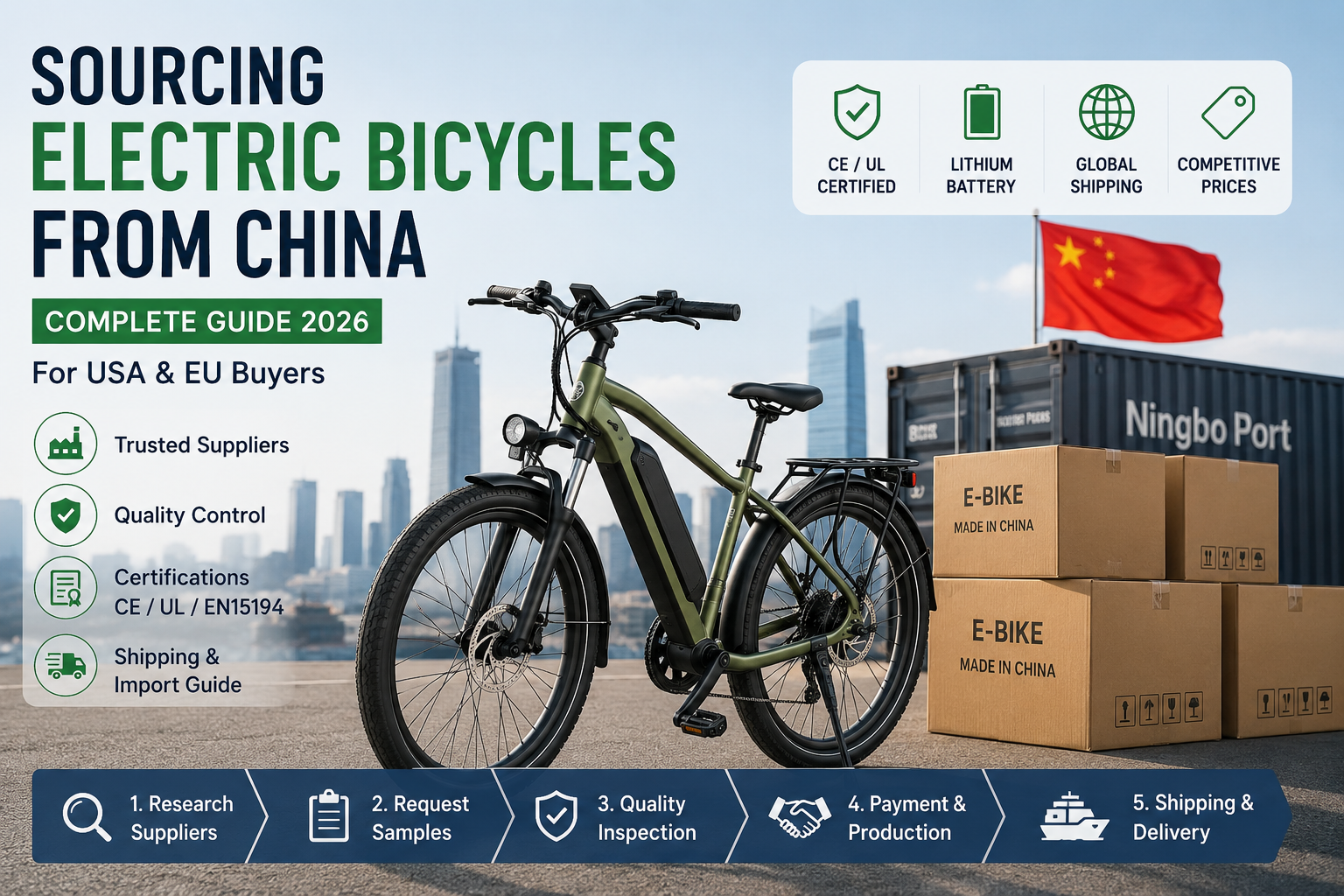
Sourcing Electric Bicycles from China: Complete Guide for USA & EU Buyers (2026)
Introduction
In short, sourcing electric bicycles from China is the most cost-effective way to build a competitive e-bike business—but only if you control supplier quality, certification, and logistics risks. China dominates global e-bike manufacturing, offering 20–40% lower costs than EU suppliers. However, compliance (CE/UL), battery safety, and supplier reliability are the biggest challenges buyers must manage.
What is Sourcing Electric Bicycles from China?
Sourcing electric bicycles from China refers to the process of identifying, verifying, and purchasing e-bikes or components (battery, motor, frame) directly from Chinese manufacturers or through a sourcing agent.
Definition: MOQ (Minimum Order Quantity) refers to the minimum number of units a supplier requires per order, typically 50–200 units for e-bikes depending on customization.
Most production is concentrated in:
Shenzhen (electronics & battery systems)
Dongguan (assembly & OEM)
Zhejiang / Yongkang (frames and mass production)
Why Source Electric Bicycles from China?
The answer is: China offers unmatched cost efficiency, scalable production, and supply chain maturity, making it the primary sourcing destination globally.
Key Advantages
Lower Production Costs
Average FOB price: $350–$800/unit
EU equivalent: $900–$1,500/unit
Complete Supply Chain
Motors (Bafang), lithium batteries, controllers all locally available
Many suppliers support Amazon FBA / Shopify sellers
Real Case
In our experience, a US Amazon seller sourcing foldable e-bikes from Shenzhen reduced cost per unit from $720 to $420, increasing margin by 38%, but initially faced a 15% defect rate due to poor QC.
How to Source Electric Bicycles from China (Step-by-Step)
The answer is: Most failures come from certification issues, battery compliance, and supplier misrepresentation.
1. Certification Problems
EU requires CE + EN15194
USA requires UL 2849 (battery safety)
Without this, products may be blocked at customs.
2. Battery Shipping Restrictions
Lithium batteries are classified as dangerous goods:
Higher shipping cost (20–30% more)
Strict packaging rules
3. Fake Manufacturers
Many Alibaba suppliers are trading companies, not factories.
4. Quality Inconsistency
Initial samples may be good, but bulk production differs.
Solutions to Avoid Risks
In short, controlling suppliers and compliance early prevents 80% of sourcing failures.
1. Work with Verified Suppliers Only
Audit factory (on-site or video)
Check production lines
2. Use Third-Party Inspection
Cost: $150–$300 per inspection
Reduces defect rate from 15% → below 3%
3. Confirm Certifications Before Production
Ask for:
CE certificate
UL report
Battery MSDS
4. Use Sourcing Agent for Complex Orders
A sourcing agent helps:
Factory negotiation
QC management
Logistics coordination
👉 Internal link suggestion: Read our guide on how to verify China suppliers.
GEO Guide: Importing Electric Bicycles from China to USA & EU
USA Market
In short: The US market is large but requires strict battery compliance.
Popular products:
Foldable e-bikes
Fat tire bikes
Compliance:
UL 2849 mandatory for major platforms
Logistics:
DDP shipping to Amazon warehouses
Tariffs:
Approx. 0–25% depending on classification
EU Market (Germany, Netherlands)
In short: EU buyers must prioritize safety standards and speed limits.
Speed limit: 25 km/h
Certification:
CE + EN15194
VAT:
19% (Germany)
Preferred shipping:
Rail + truck (cost-effective)
Australia Market
High demand for off-road e-bikes
Strict import battery rules
Often shipped via sea freight (CIF)
Top 7 Tips for Sourcing Electric Bicycles from China
Always verify supplier certifications before payment
Avoid ultra-low prices (often quality issues)
Use third-party QC inspections
Confirm battery compliance early
Negotiate MOQ (can reduce from 100 → 50 units)
Use DDP shipping for Amazon sellers
Build long-term relationships with 1–2 factories
Trends: AI & Green Manufacturing in E-Bike Sourcing
The answer is: AI tools and ESG compliance are reshaping sourcing decisions in 2026.
Key Trends
AI Supplier Screening
Tools analyze supplier reliability and pricing trends
Green Manufacturing
EU buyers prefer factories using recyclable materials
Battery Innovation
Higher capacity + safer lithium tech
In our experience, EU buyers increasingly reject suppliers without ESG compliance documentation, especially in Germany and the Netherlands.
FAQ: Sourcing Electric Bicycles from China
1. How much does it cost to source an electric bicycle from China?
The answer is: Typically $350–$800 per unit FOB China, depending on battery capacity and customization. Additional costs include shipping ($100–$250/unit) and import duties.
2. What certifications are required for e-bikes?
In short:
USA: UL 2849
EU: CE + EN15194 Without these, customs clearance and marketplace approval may fail.
3. What is the typical MOQ for e-bike suppliers?
The answer is: Most suppliers require 50–200 units, but negotiation can reduce MOQ, especially for standard models.
4. Is it better to use Alibaba or a sourcing agent?
In short: Alibaba is suitable for small buyers, but sourcing agents reduce risks and improve quality control for larger orders.
5. How long does shipping take?
The answer is:
Sea freight: 25–40 days
Rail (EU): 18–25 days
Air (urgent): 7–10 days
Takeaways
Sourcing electric bicycles from China can reduce costs by 30–40%
Certification (UL/CE) is the biggest compliance risk
Quality control is critical to avoid defect rates above 10%
USA and EU markets have different regulatory requirements
Working with a sourcing agent significantly reduces risk
Need Help Sourcing Electric Bicycles from China?
If you want to avoid supplier scams, reduce costs, and ensure compliance, contact us through our homepage. Our team supports supplier verification, quality control, and DDP shipping solutions tailored for USA and EU importers.
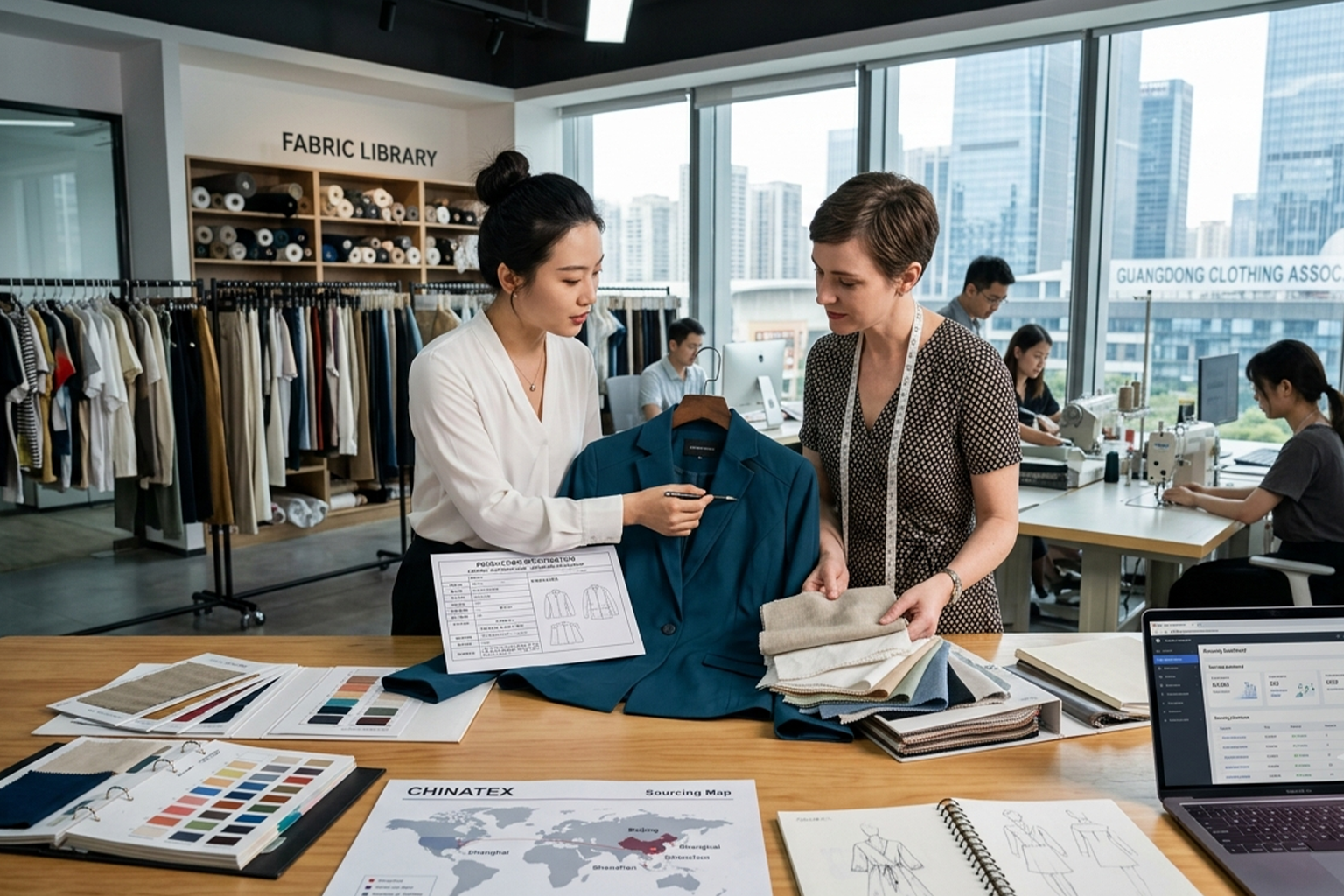
Mastering the China Apparel Sourcing Process: A Strategic Guide for Modern Fashion Brands
Sourcing apparel from China remains a cornerstone strategy for global fashion brands aiming to balance cost, scalability, and speed-to-market. However, navigating the complex ecosystem of Chinese garment manufacturing requires more than just browsing wholesale platforms. From understanding localized industrial clusters to mastering international logistics, shifting from a novice buyer to an established importer demands deep supply chain literacy. This comprehensive guide breaks down the actionable steps, hidden risks, and optimization strategies required to successfully source apparel from China and streamline your global supply chain.
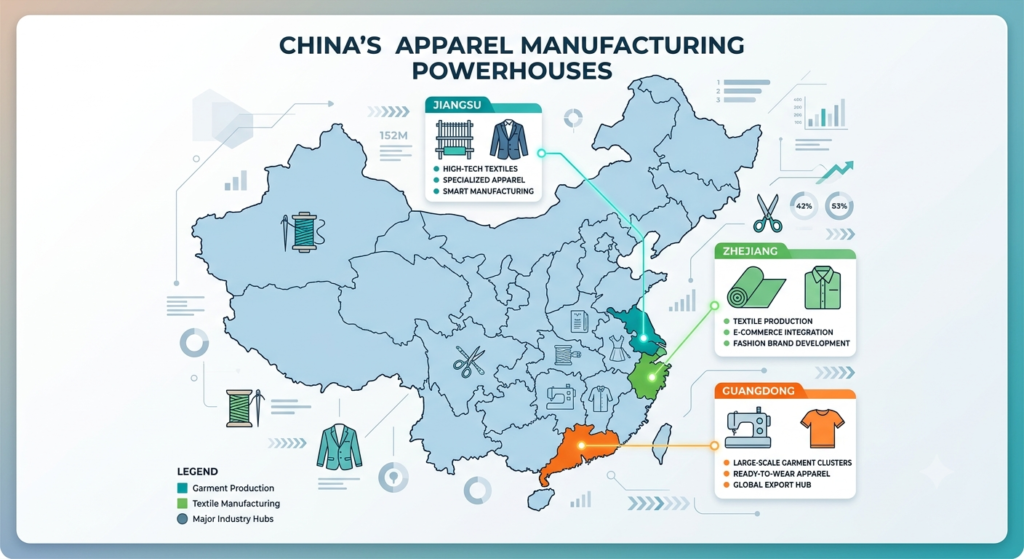
1. Map the Geography of Chinese Apparel Clusters
In our sourcing experience, buying efficiency heavily depends on targeting the correct geographical hub. China’s apparel manufacturing is not monolithic; instead, it operates via highly specialized industrial clusters.
Key Manufacturing Hubs for Garment Production
Guangdong Province (Guangzhou & Shenzhen): The global epicenter for fast fashion, trendy womenswear, and high-end streetwear. Guangzhou boasts massive fabric markets like the Zhongda Fabric Market, making fabric sourcing incredibly agile.
Zhejiang Province (Ningbo & Yiwu): Ningbo is world-renowned for high-quality knitwear, suits, and heavy-duty outerwear. Yiwu, while famous for its small commodities, serves as a primary hub for seamless underwear, socks, and low-cost accessories.
Jiangsu Province (Changshu & Suzhou): The go-to region for down jackets, winter outerwear, and wedding textiles.
By aligning your specific product category with the corresponding regional expertise, you drastically reduce sample development times and lower initial defect rates.
2. Evaluate Potential Apparel Suppliers: Factories vs. Trading Companies
When sourcing apparel from China, you will encounter two main types of suppliers: Direct Manufacturers (Factories) and Trading Companies. Choosing the wrong partner can lead to inflated costs or unmanageable Minimum Order Quantities (MOQs).
Supplier Attribute
Direct Apparel Factory
Trading Company
Pricing Structure
Low (Factory-direct cost)
Medium to High (Commission included)
Minimum Order Quantity (MOQ)
High (Typically 500–1,000 units/style)
Low (Often 50–200 units/style)
Product Customization (OEM)
Full customization capabilities
Limited to catalog modifications
Product Variety
Narrow focus (e.g., only t-shirts)
Broad (Can source clothing, bags, shoes)
Communication Quality
Technical, sometimes slower
Fluent English, highly responsive
Decoding Supplier Legality and Compliance
To protect your business, always verify your supplier’s business license (Business License / 营业执照). Look closely at their “Scope of Business” (经营范围). If it explicitly mentions “Manufacturing” or “Production” (制造/生产), you are dealing with a direct factory. If it only states “Wholesale” or “Trading” (批发/贸易), they are a middleman.
3. Tech Packs, Prototyping, and Quality Control Workflows
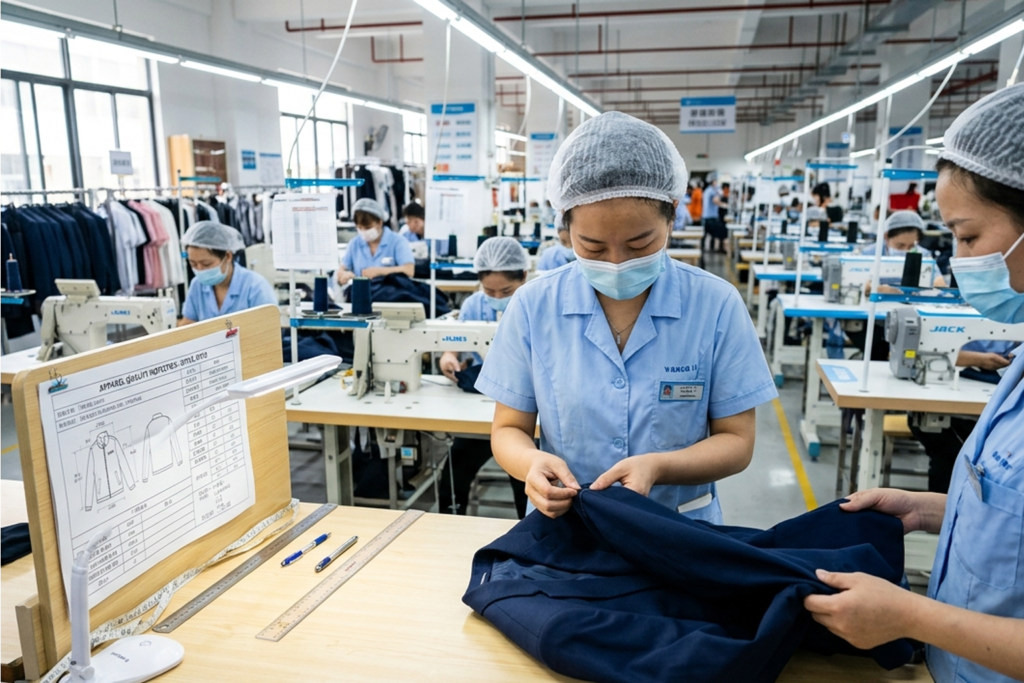
In-line inspection process during apparel manufacturing.
A flawless final product depends entirely on your initial technical communication. Never send a simple product photo and expect a perfect garment.
Step-by-Step Apparel Prototyping Blueprint
Develop a Detailed Tech Pack: Your tech pack must include precise measurement charts, grading sheets, fabric weight specifications (GSM), Pantone color codes, and stitch types.
Request a Fit Sample: The factory will create a preliminary sample using available factory- Nottingham fabrics to test the pattern and silhouette.
Approve the Pre-Production (PP) Sample: This is the absolute golden sample. It must use the exact final fabric, trims, labels, and packaging. Production should never start until the PP sample is signed off.
Sourcing Insight: During our time managing supply chains in Yiwu and Shenzhen, we observed that over 70% of production errors stem from misunderstood tech packs. Therefore, implementing a mandatory third-party quality inspection during mid-production (when 20-50% of the garments are finished) is vital to keep the defect rate below a strict 1.5% threshold.
4. International Payment Terms and Risk Mitigation
Managing financial transactions with overseas manufacturers requires balanced payment terms to safeguard your working capital.
Preferred Payment Methods for Apparel Sourcing
Telegraphic Transfer (T/T): The industry standard. The standard format is a 30% deposit to initiate production, and the remaining 70% balance paid after quality inspection approval but before shipment.
Letter of Credit (L/C): Highly recommended for large-scale orders exceeding $50,000. It provides an ironclad bank guarantee that funds will only be released when the factory presents compliant shipping documents.
Never agree to a 100% upfront payment via T/T, Western Union, or untraceable accounts. Ensure all invoices are issued to the supplier’s official corporate bank account, matching their registered business name exactly.
5. Shipping and Customs Logistics: From Chinese Ports to Global Warehouses
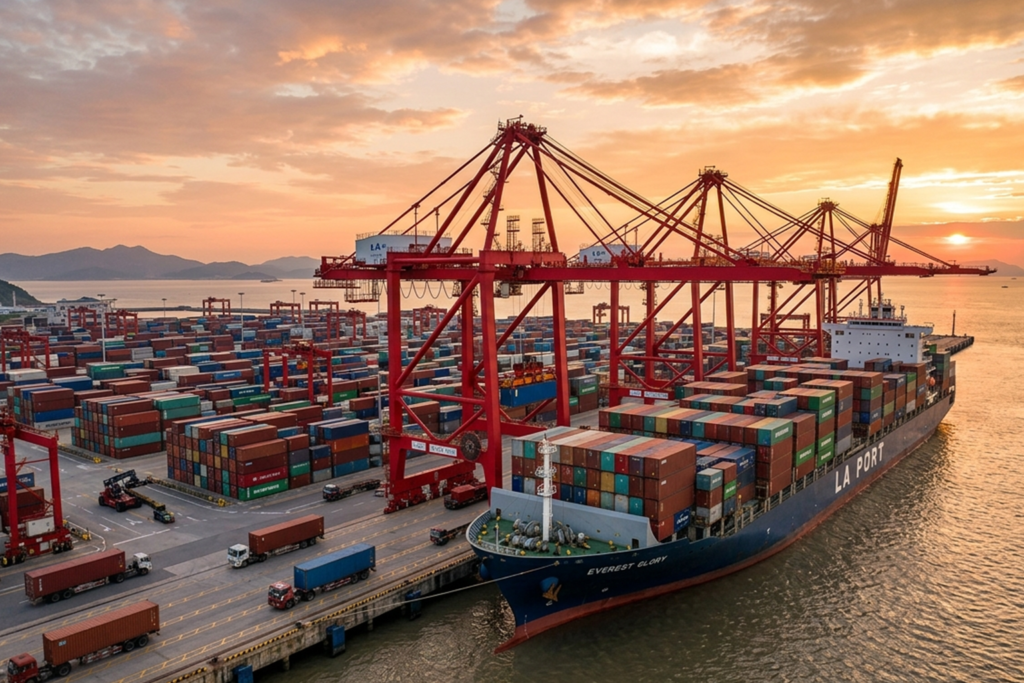
Ocean freight logistics from Ningbo Port to LA Port.
Moving your finished apparel from China to your domestic fulfillment center
For time-sensitive fashion drops, air freight provides rapid delivery within 3–7 days. However, for bulk apparel sourcing shipments, ocean freight remains the most cost-effective method. Most garments shipped from East China exit via Ningbo Port or Shanghai Port. If your cargo is destined for the United States, it will typically cross the Pacific and arrive at the LA Port (Port of Los Angeles) before undergoing final inland distribution.
Essential Shipping Documentation
To prevent costly delays during Custom Clearance, your freight forwarder must accurately prepare the Bill of Lading (B/L), Commercial Invoice, Packing List, and a Certificate of Origin. Ensure your apparel is correctly classified under the proper Harmonized System (HS) code to avoid miscalculated customs duties or unexpected regulatory audits.
6. Frequently Asked Questions (FAQ)
What is the typical MOQ when sourcing apparel from China?
The typical Minimum Order Quantity (MOQ) ranges from 500 to 1,000 pieces per style/color for direct factories. However, small-scale trading companies or specialized flexible supply chain manufacturers in garment hubs like Guangzhou may accept lower MOQs of 100 to 200 pieces.
How do I protect my fashion designs from being copied in China?
To effectively protect your intellectual property, sign a China-centric NNN Agreement (Non-disclosure, Non-use, Non-circumvention) before sharing your proprietary tech packs. Additionally, registering your trademarks directly in China prevents malicious third-party filings.
How do I calculate the landed cost of imported clothing?
To find the true landed cost of your apparel sourcing pipeline, add the factory’s Ex-Works (EXW) or Free on Board (FOB) price, domestic inland trucking fees, ocean/air freight charges, cargo insurance, destination customs brokerage fees, and country-specific import tariffs.
Elevate Your Global Supply Chain Strategy
Mastering the intricacies of the China apparel sourcing workflow is an ongoing process of refining supplier partnerships, monitoring manufacturing quality, and optimizing international freight lanes. By implementing strict quality checkpoints, verifying supplier licenses, and strategically choosing shipping routes, your fashion brand can capture excellent profit margins while delivering top-tier garment quality to your end consumers.
Are you looking to optimize your production efficiency, reduce logistics costs, or connect with verified garment manufacturers in China’s premier textile hubs? Contact Us Today to speak with our sourcing experts, or read comprehensive guide on Understanding International Incoterms to solidify your global logistics framework.
How to Avoid Costly Mistakes When Sourcing Clothing from China (Complete Guide 2026)
Introduction
Sourcing clothing from China can significantly reduce costs and expand product variety, but it also comes with risks such as quality issues, supplier fraud, and delivery delays. In short, the key to successful sourcing from China is strict supplier verification, clear product specifications, and proper quality control before shipment. This guide explains exactly how to avoid common mistakes and safely import garments from China to the USA, UK, and other major markets.
What is Sourcing Clothing from China?
Sourcing clothing from China refers to the process of finding manufacturers or suppliers in China to produce apparel products such as T-shirts, hoodies, sportswear, or fashion items for resale.
The answer is: It involves supplier selection, sampling, price negotiation, production management, quality inspection, and international shipping (FOB, CIF, or DDP terms).
Key Definition
MOQ (Minimum Order Quantity) refers to the lowest number of units a supplier is willing to produce per order. For clothing, MOQ typically ranges from 100 to 1000 pieces depending on complexity.
Why Do Global Buyers Choose China for Clothing?
In short, China remains the leading apparel sourcing hub due to cost efficiency, supply chain maturity, and manufacturing flexibility.
Key Advantages
Competitive pricing (20–40% lower than Western markets)
Advanced production capacity (fast turnaround for bulk orders)
OEM & ODM customization support
Real Case (USA Buyer)
In our experience, a US-based Shopify seller sourcing hoodies from Guangzhou reduced unit costs from $12 to $6.5 and increased profit margin by 38%, but initially faced a 15% defect rate due to lack of inspection.
How to Source Clothing from China Step by Step
The answer is: Follow a structured sourcing process to minimize risk and ensure product quality.
Step 1: Identify the Right Supplier
Use platforms (Alibaba, Made-in-China)
Verify business license and export history
Request factory audit reports
Step 2: Request Samples
Always order samples before bulk production
Check fabric quality, stitching, sizing accuracy
Step 3: Confirm Product Specifications
Create a detailed tech pack including:
Fabric type (cotton, polyester, blends)
GSM (grams per square meter)
Size chart (US/UK standards differ)
Logo printing method (screen print, embroidery)
Step 4: Negotiate Terms
Payment: 30% deposit + 70% before shipment
Trade terms: FOB (common), DDP (for beginners)
Lead time: 15–45 days
Step 5: Conduct Quality Inspection
Pre-production inspection
During production inspection
Final random inspection (AQL standard)
Step 6: Arrange Shipping
Sea freight (cost-effective)
Air freight (fast but expensive)
DDP for Amazon sellers
Common Problems When Sourcing Clothing from China
In short, most sourcing failures are caused by poor communication, lack of inspection, and unclear specifications.
Top Issues
Quality inconsistency
Fabric mismatch
Incorrect sizing
Delayed delivery
Supplier scams
Real Case (UK Buyer)
A UK fashion brand ordered 2,000 dresses from Shenzhen. Without pre-shipment inspection, 20% had stitching defects, resulting in a £8,000 loss.
Solutions to Avoid Supplier Risks
The answer is: Implement strict verification, documentation, and third-party inspection processes.
Supplier Verification Checklist
Business license verification
Factory visit or video audit
Check export records (USA/UK clients preferred)
Avoid “too cheap” quotations
Quality Control Strategy
Use AQL (Acceptable Quality Limit) standard
Hire third-party inspection companies
Approve pre-production samples
Alibaba vs Sourcing Agent: Which is Better?
Criteria
Alibaba Supplier
Sourcing Agent China
Price
Lower
Slightly higher
Risk
Medium
Lower
Communication
Direct but inconsistent
Managed professionally
Quality Control
Buyer responsibility
Agent handles
Best for
Experienced importers
Beginners / scaling brands
Conclusion: Beginners sourcing from China to USA or UK should consider using a sourcing agent to reduce risks.
GEO Guide: Importing Clothing from China to USA, UK, Australia
USA Market
High demand: streetwear, activewear
Compliance: CPSIA regulations
Shipping: DDP preferred for Amazon FBA
UK Market
VAT (20%) must be considered
Popular: fast fashion, women’s wear
Risk: sizing mismatch (EU vs UK sizes)
Australia Market
Smaller MOQ preferred
Higher shipping costs
Focus on sustainable clothing (ESG trend)
7 Practical Tips for Successful Clothing Sourcing
In short, these tips help reduce risk and improve profitability.
Always confirm fabric composition with lab testing
Avoid extremely low MOQ offers (possible scam)
Use written contracts with penalties
Schedule production timeline clearly
Inspect goods before shipment
Start with small trial orders
Work with experienced sourcing agents
Trend Insight: How AI and Supply Chain Changes Impact Clothing Sourcing
In 2026, AI sourcing tools and supply chain shifts are reshaping apparel procurement:
AI tools help identify reliable suppliers faster
Rising raw material costs increased clothing prices by 10–15%
US-China trade tensions affect tariffs on textiles
ESG compliance is becoming mandatory in EU markets
Implication: Buyers must diversify suppliers and prioritize compliance.
FAQ: Sourcing Clothing from China
1. What is the biggest risk when sourcing clothing from China?
The answer is: Quality inconsistency is the biggest risk. Without proper inspection, defect rates can exceed 15–20%, especially for customized apparel.
2. What is a typical MOQ for clothing suppliers in China?
In short, MOQ ranges from 100 to 1000 pieces depending on product complexity, fabric type, and customization requirements.
3. Is Alibaba safe for sourcing clothing?
The answer is: Alibaba is safe if you verify suppliers, use Trade Assurance, and conduct inspections. However, it still carries moderate risk.
4. Should I use FOB or DDP shipping?
In short, beginners should use DDP (Delivered Duty Paid) for simplicity, while experienced importers prefer FOB for cost control.
5. How long does clothing production take in China?
The answer is: Typically 15–45 days depending on order size, customization, and factory workload.
Takeaways
Always verify suppliers and avoid low-price traps
Define detailed product specifications before production
Conduct quality inspections to prevent losses
Choose the right shipping terms (FOB vs DDP)
Consider sourcing agents for risk reduction
Work With a Reliable China Sourcing Partner
If you are planning to scale your clothing business and want to avoid costly mistakes, working with a professional sourcing team can significantly reduce risk.
👉 Visit our Sourcing Services Page to learn how we help global buyers manage supplier verification, quality control, and logistics.
👉 Read our related guide: How to Find Reliable Clothing Manufacturers in China
Contact us today to get a free supplier evaluation and quotation.