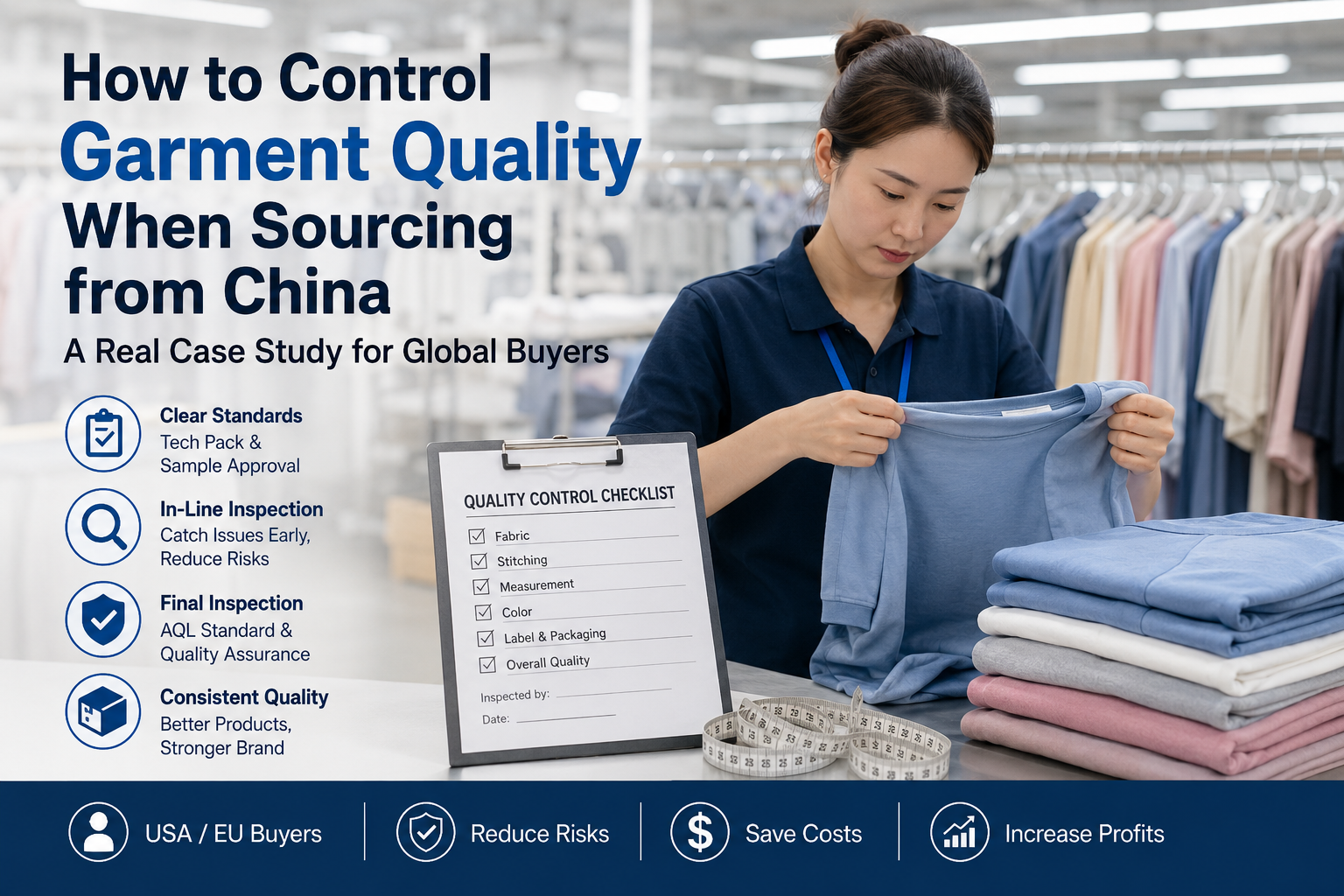
Garment quality control in China is the process of measuring finished and in-progress clothing against a written specification, at fixed points in production, using a sampling standard both sides agreed to in advance. If any of those three parts is missing — spec, timing, or standard — you are not doing QC, you are doing an opinion.
Most apparel disputes we see are not about workmanship. They are about two people holding different definitions of “the same garment”.
What garment quality control actually measures
Not “quality” in the abstract. Four measurable things:
Measurement. A tech pack lists points of measure with tolerances. A medium dress might allow ±1 cm at the chest and ±0.5 cm at the neckline. Anything inside tolerance is not a defect, no matter how it looks on a hanger.
Material performance. Fabric weight per square metre, shrinkage after wash, colourfastness when rubbed and washed, and whether the trim matches the approved card. Substitution is the most common hidden failure in low-cost runs.
Construction. Seam strength, stitch density, symmetry of left and right, alignment of patterns at the seam, and the finish inside the garment where buyers rarely look.
Presentation. Folding, polybag, hangtag, size stickering, carton assortment and carton marks. Retailers reject shipments over packing as often as over stitching.
The four inspection gates
| Gate | When | What it catches |
|---|---|---|
| Pre-production sample | Before bulk fabric is cut | Wrong specs, wrong trim, misunderstood construction |
| In-line inspection | First 10-20% of production | Systematic errors before they repeat across the run |
| Pre-shipment inspection | When 80-100% is packed | Defect rate against AQL, measurement drift, packing errors |
| Carton audit | Before the container closes | Assortment, size ratios, carton marks, shipping documents |
Skipping the first two and buying only the pre-shipment inspection is the most common and most expensive shortcut in apparel sourcing. By the time a PSI finds a systematic measurement error, the fabric is already cut.
A one-page checklist you can send to a factory
- Tech pack with points of measure and tolerances, signed and dated
- Approved pre-production sample, one held by the factory, one by you
- Fabric and trim cards with weight, composition and colour reference
- Agreed AQL: 2.5 for major defects, 4.0 for minor, zero for critical
- Packing specification: fold, polybag, hangtag, size sticker, carton marks
- Inspection timing in writing: who attends, what access, when it happens
If a factory cannot work from that page, the problem is not the checklist.
What a usable inspection report contains
A report is a record, not a verdict. Look for: the sampling plan and how many pieces were pulled, the AQL applied, a defect list with photographs, measured values against the spec, the inspector’s name, the date, and an explicit statement of what was not checked. A report that concludes “all good” without numbers is a piece of paper.
The catch worth naming: an inspection samples a batch. It tells you whether that batch is acceptable, not whether the factory will repeat it next season. That is what the audit is for — what a factory audit costs and what it covers is the other half of this picture.
What causes most garment defects
Four causes account for the majority of rejections we see, and none of them are mysterious.
Spec drift. The tech pack says one thing, the sample says another, and production follows the sample. This happens when the pre-production sample is approved verbally rather than against the written spec.
Material substitution. A fabric that looks the same but weighs less, or a trim that behaves differently under heat. It is invisible in a photo and obvious in a wash test.
Skipped gates. Buying only the pre-shipment inspection. By then the fabric is cut and the only remedies are rework or discount, both of which cost more than the inspections that were skipped.
Rush orders. A compressed schedule moves the in-line check to after production, which is the same as having no in-line check. Peak season is when this repeats.
What the factory can fix, and what it cannot
Worth being clear about this before you write a claim. A factory can rework seams, replace trims, re-press and re-pack. It cannot change fabric that has already been cut, and it cannot recover a week that does not exist before your ship date.
That asymmetry is the argument for spending money early. An inspection at gate two costs less than a rework at gate three, and a great deal less than a discount negotiated on a container that is already at the port.
Keeping a QC system running across seasons
The first order is the easy one to police, because everyone is paying attention. The failures usually appear on the second or third run, when the buyer stops sending the tech pack and the factory starts working from memory.
Three habits keep it stable: re-confirm the tech pack revision on every purchase order, keep the golden sample until the next one replaces it, and run the same inspection protocol on repeat orders instead of trusting the relationship. Trust is what you buy the audit for, not a substitute for it.
FAQ
How many pieces are inspected in a pre-shipment check?
It depends on the lot size and the sampling plan, not on a fixed number. Under AQL 2.5 the sample size grows with the shipment, and the acceptance number is agreed before the inspection starts. Agreeing the plan first is what stops the argument later.
Is AQL 2.5 the right standard for clothing?
It is the common default for major defects in apparel, with AQL 4.0 for minor ones and zero tolerance for critical defects such as safety issues or prohibited substances. What matters is that the standard is written into the purchase order before production, not negotiated after the report arrives.
Can I do garment QC without visiting the factory?
Yes, if someone physically stands in the factory at the agreed gates. A remote check can review photos and reports, but it cannot confirm that the garment in the photo came from the lot you are paying for. That is the difference between reviewing evidence and collecting it.
Next step
If you have a tech pack and a factory but no inspection plan, send us the product, the quantity and the destination country. We will tell you which gate to start with and what the report will contain. Email hello@linkchinascm.com or message us on WhatsApp.
For the wider sourcing picture, start with the apparel sourcing guide — clusters, suppliers, payment terms and shipping.
Leave a Reply