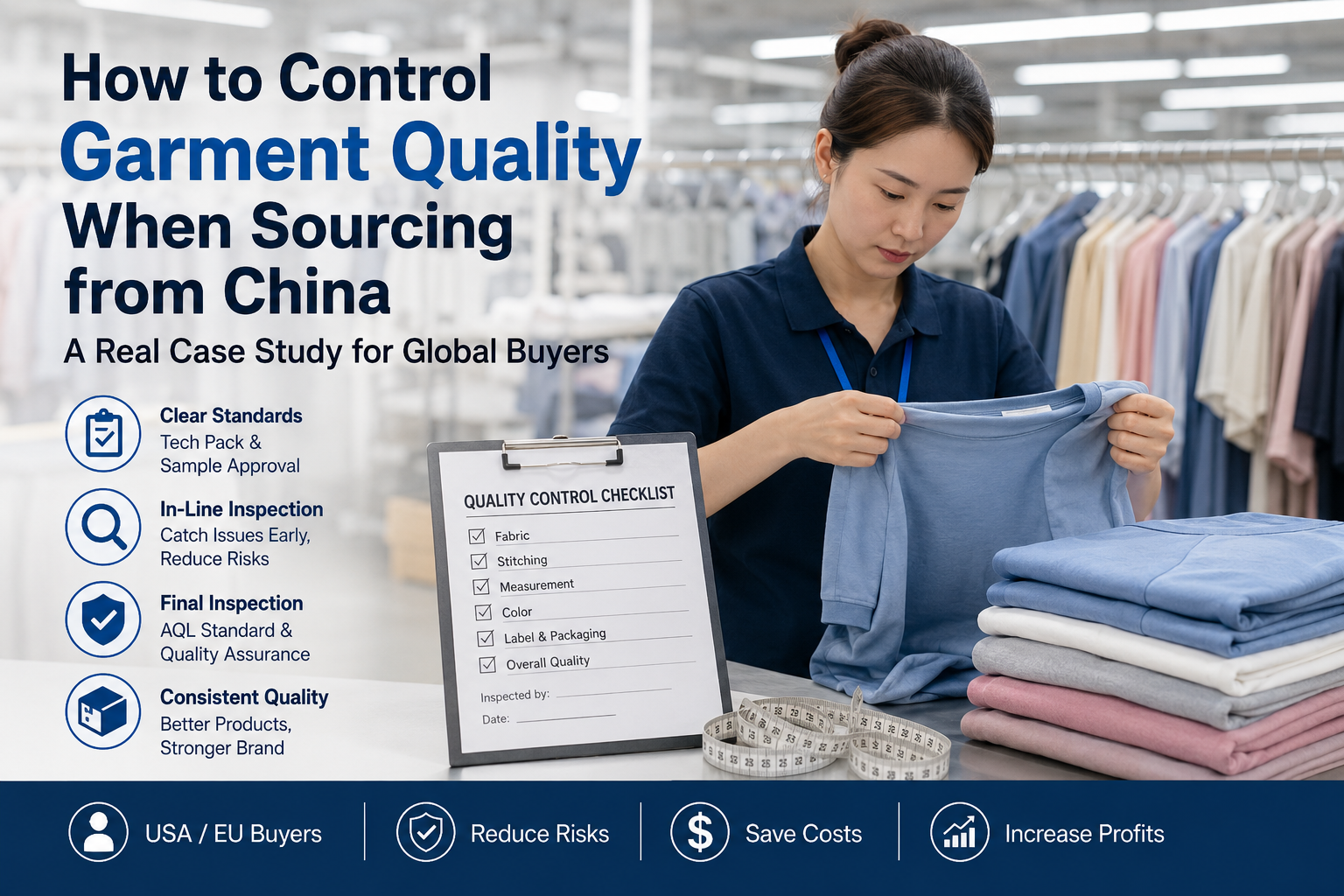
How to Control Garment Quality When Sourcing from China: A Real Case Study for Global Buyers
Introduction
In short, controlling garment quality when sourcing from China requires strict pre-production standards, in-line inspections, and final quality control backed by clear specifications and contracts. Many USA, UK, and EU buyers fail not because of bad suppliers, but because of weak quality control systems.
This article shares a real apparel sourcing case and a step-by-step quality control framework to help you avoid costly mistakes when importing clothing from China.
What is Garment Quality Control in China Sourcing?
Garment quality control refers to a structured process of ensuring clothing products meet agreed standards, specifications, and compliance requirements before shipment.
The answer is: It includes fabric inspection, size measurement, stitching checks, labeling verification, and packaging standards, typically conducted at three stages: pre-production, during production, and pre-shipment.
Key Quality Elements in Apparel
- Fabric composition (e.g., 100% cotton vs blended)
- GSM (grams per square meter)
- Stitch density and durability
- Color fastness
- Size tolerance (+/- 1–2 cm)
- Packaging accuracy
Why Quality Control is Critical for USA & EU Buyers
For buyers importing garments to USA, UK, Germany, and Canada, quality issues can lead to:
- Amazon or Shopify negative reviews
- Customs rejection (compliance issues like CPSIA in the USA)
- Return rates above 20%
- Brand damage
Example: Compliance Requirements
| Country | Requirement | Risk |
|---|---|---|
| USA | CPSIA labeling | Shipment held |
| EU (Germany) | REACH chemical compliance | Fines |
| UK | Fiber labeling accuracy | Retail rejection |
Real Case Study: 30% Defect Rate in Women’s Dresses (USA Buyer)
Background
- Buyer: USA Shopify brand
- Product: Women’s summer dresses
- Quantity: 5,000 pcs
- Supplier location: Guangzhou, China
- Trade term: FOB Shenzhen
Problem
After receiving goods, the buyer discovered:
- 30% dresses had size deviation >3cm
- Loose stitching in shoulder areas
- Color mismatch vs approved sample
Root Causes
1. No Pre-Production Sample Approval
The buyer approved photos, not physical samples.
2. No Size Spec Sheet
Supplier used their own “standard size,” not the buyer’s.
3. No In-line Inspection
Problems were discovered too late (after production finished).
How We Solved It: Step-by-Step Quality Control System
Step 1: Create a Detailed Tech Pack
A Tech Pack (Technical Package) defines all product specifications.
Include:
- Fabric type & GSM
- Measurement chart (with tolerance)
- Stitching requirements
- Color Pantone codes
- Label & packaging details
Step 2: Approve Pre-Production Sample (PPS)
Never mass produce without PPS approval.
Checklist:
- Fit accuracy
- Fabric feel
- Color match
- Washing test
Step 3: In-Line Inspection (During Production)
In-line inspection means checking goods when 20–50% production is completed.
Benefits:
- Catch defects early
- Reduce rework cost
- Ensure consistency
Step 4: Final Random Inspection (FRI)
The answer is: Final inspection is conducted when 80–100% goods are packed, using AQL standards.
AQL (Acceptable Quality Limit)
AQL refers to the maximum number of defects allowed in a sample batch.
| Inspection Level | Major Defect | Minor Defect |
|---|---|---|
| AQL II | 2.5% | 4.0% |
Step 5: Packaging & Label Verification
Common issues:
- Wrong size labels
- Missing barcodes
- Incorrect country of origin
Common Problems in Garment Sourcing from China
1. Fabric Substitution
Suppliers may switch to cheaper fabric to save cost.
2. Size Inconsistency
Different production lines = inconsistent sizing.
3. Color Variation
Especially in bulk dyeing processes.
4. Poor Stitching Quality
Untrained workers or rushed production.
Solutions: Top 7 Tips to Control Apparel Quality
- Always use a Tech Pack
- Approve physical samples (not photos)
- Define AQL standards in contract
- Hire third-party inspection
- Use clear size tolerance (±1–2 cm)
- Conduct in-line inspection
- Work with experienced sourcing agents
Sourcing Agent vs Alibaba Supplier: Quality Control Comparison
| Factor | Alibaba Supplier | Sourcing Agent |
|---|---|---|
| Communication | Direct | Managed |
| QC Control | Limited | Strong |
| Risk Level | Medium-High | Low |
| Cost | Lower | Slightly higher |
| Reliability | Varies | Stable |
GEO Insights: Importing Garments from China to USA & Europe
USA Buyers
- Prefer DDP shipping (door-to-door)
- Must comply with CPSIA
- Popular products: T-shirts, dresses, activewear
EU Buyers (Germany, UK)
- Focus on sustainability (ESG trend)
- Require REACH compliance
- Prefer eco-friendly fabrics
Trend Insight: AI + Quality Control in 2026
More buyers now use:
- AI fabric inspection tools
- Automated measurement systems
- Digital Tech Packs
In our experience, AI reduces defect rates by up to 15–20%.
FAQ: Garment Quality Control in China
1. What is the most common quality issue in clothing imports?
The answer is: Size inconsistency and stitching defects are the most common issues, especially without proper Tech Packs and inspections.
2. How much does inspection cost in China?
Typically $150–$300 per man-day, depending on city (e.g., Shenzhen, Yiwu).
3. What is MOQ in apparel sourcing?
MOQ (Minimum Order Quantity) refers to the smallest order a supplier accepts, usually 300–1000 pcs per style.
4. Should I choose FOB or DDP shipping?
- FOB: More control, lower cost
- DDP: Easier, includes customs clearance
5. Can I control quality remotely?
Yes, by:
- Hiring third-party inspectors
- Using sourcing agents
- Requesting video inspections
Takeaways
- Quality issues often come from lack of clear specifications, not bad suppliers
- Always use Tech Packs + PPS approval
- Conduct in-line and final inspections
- Define AQL standards in contracts
- Consider using a China sourcing agent for better control
Need Help with Garment Sourcing from China?
If you are sourcing apparel for USA, UK, or EU markets, our team can help you:
- Find reliable factories in Guangzhou, Shenzhen, Yiwu
- Manage production & quality control
- Handle shipping (FOB / CIF / DDP)
👉 Contact us through our homepage to get a free sourcing consultation